Mango — The King of Fruits from Bangladesh
A summer journey through orchards, markets and the flavours worth waiting for
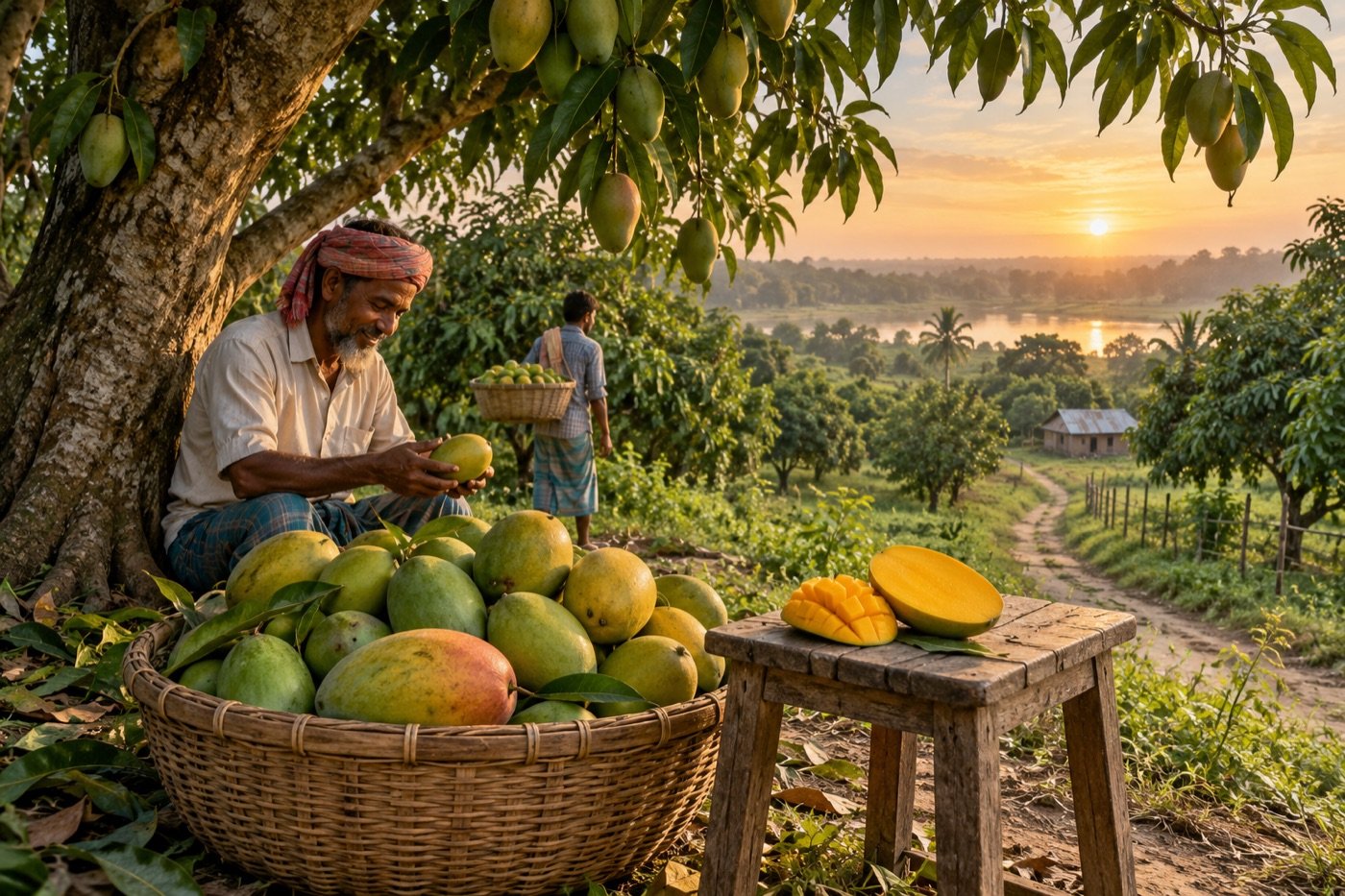
A harvest worth sharing with friends and family. AI-generated editorial illustration.
The box has barely reached the table before someone asks to open it. Inside are mangoes: some green, others washed with yellow. One has a small mark on its skin that makes it look less impressive than its neighbours. Nobody seems particularly concerned about that.
A mango is lifted towards the nose. There is a pause, then a smile. The fragrance has answered the first question. The second will require a knife.
Imagine this scene in a Bangladeshi home on a summer afternoon. Someone fetches plates. Someone insists the fruit needs another day. Someone else has already started cutting. A delivery has become a gathering, and the king of fruits has everyone’s attention.
To understand this affection, follow the fruit back towards the orchard. There is much more to discover than sweetness.
Picture a village afternoon just after a summer rain. The road is dark with water, a bicycle bell disappears around the bend and the mango tree is dripping from every leaf. A child hears the soft thud of a fruit landing in the grass. For a moment, the whole yard becomes quiet. Then everyone runs.
Follow the Road into Mango Country
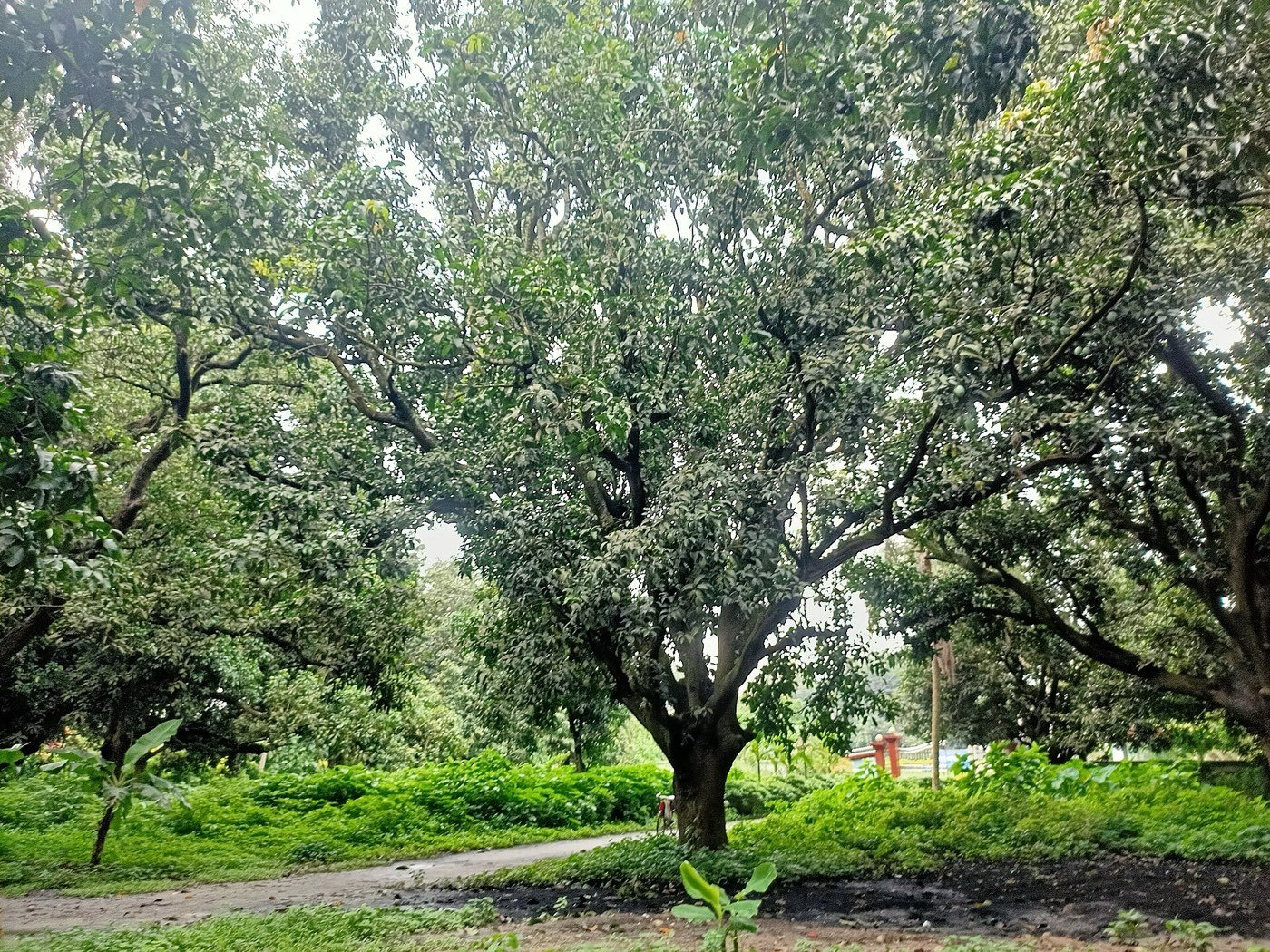
An old mango tree at Horticulture in Chapainawabganj, Bangladesh. Photo: Shamim Ahammed sumon, resized, CC BY-SA 4.0, via Wikimedia Commons.
Leave the city behind and imagine travelling west, towards the mango-growing landscapes of Rajshahi and Chapainawabganj. Villages, tea stalls and cultivated fields pass beside the road. Then the orchards begin: broad trees, long leaves and fruit suspended in the shade.
Naogaon belongs on this journey too. Farther north, Rangpur is associated with Haribhanga mangoes. Bangladesh’s mango story stretches beyond a single district, and each stop gives you another reason to ask what is growing nearby.
The season does not begin and finish on one date. In many commercial districts, the first varieties can start appearing around mid-May. Gopalbhog and early mangoes come before Khirsapat or Himsagar; Langra follows later, while Amrapali and Fazli often arrive in June. Some BARI varieties and late cultivars continue into July and even August. The exact calendar changes with district, weather and the tree itself. That is why a Bangladeshi family may have one tree ready in May, another in June and another still green when the first monsoon rain arrives.
In a home orchard, this staggered ripening feels like luck. In a commercial orchard, it becomes a management plan: the grower chooses varieties with different harvest windows so labour, transport and sales do not all arrive on the same day.
Beneath the trees, the scene appears peaceful. Harvesting demands judgement. A grower has to consider whether the fruit is mature enough, how it will be handled and how far it must travel. The most colourful mango is not necessarily the one to pick first.
Maturity and ripeness are related, but they are not identical. Mangoes can continue ripening after harvest; picking fruit too early can still compromise the eating experience. Getting that decision right is part of the work hidden inside every good box.
It is tempting to imagine that sunshine alone creates great fruit. Spend a little longer with the idea of the orchard and something else comes into focus: patience, observation and people who know their trees.
A fruit with an older story
Mango did not arrive in Bangladesh as a modern import with a single official arrival date. The tree belongs to the wider Indo-Burmese and South Asian region, where mango has been cultivated for thousands of years. Over centuries, people carried seeds, planted trees near homes and selected the fruits they wanted to keep. That is why the history feels less like a straight line and more like a family tree: one village keeps a seedling, another village names it, and eventually a local mango becomes part of the identity of a whole district.
Bangladesh’s own mango landscape was shaped by this long human process. The country’s agricultural references describe mango as one of the oldest and most important fruit trees in the homestead landscape, while the Mango Research Station at Chapainawabganj was established in 1985 to study cultivation and improve varieties. The science is relatively recent; the relationship between a family and its tree is much older.
That distinction matters. A mango tree beside a house is not just a crop. It can be shade, food, a memory, a small emergency income and a reason for relatives to visit in summer. Some families sell a portion of the harvest; others keep the best fruit for children, guests and neighbours. The tree is often counted in the family’s life before it is counted in kilograms.
In a Bangladeshi village, the orchard is not always a separate, fenced plantation. A mango tree may stand beside a homestead, lean over a path or stretch its branches above a pond. Children grow up knowing which trees belong to which family, which branches ripen first and where the sweetest fruit usually hides.
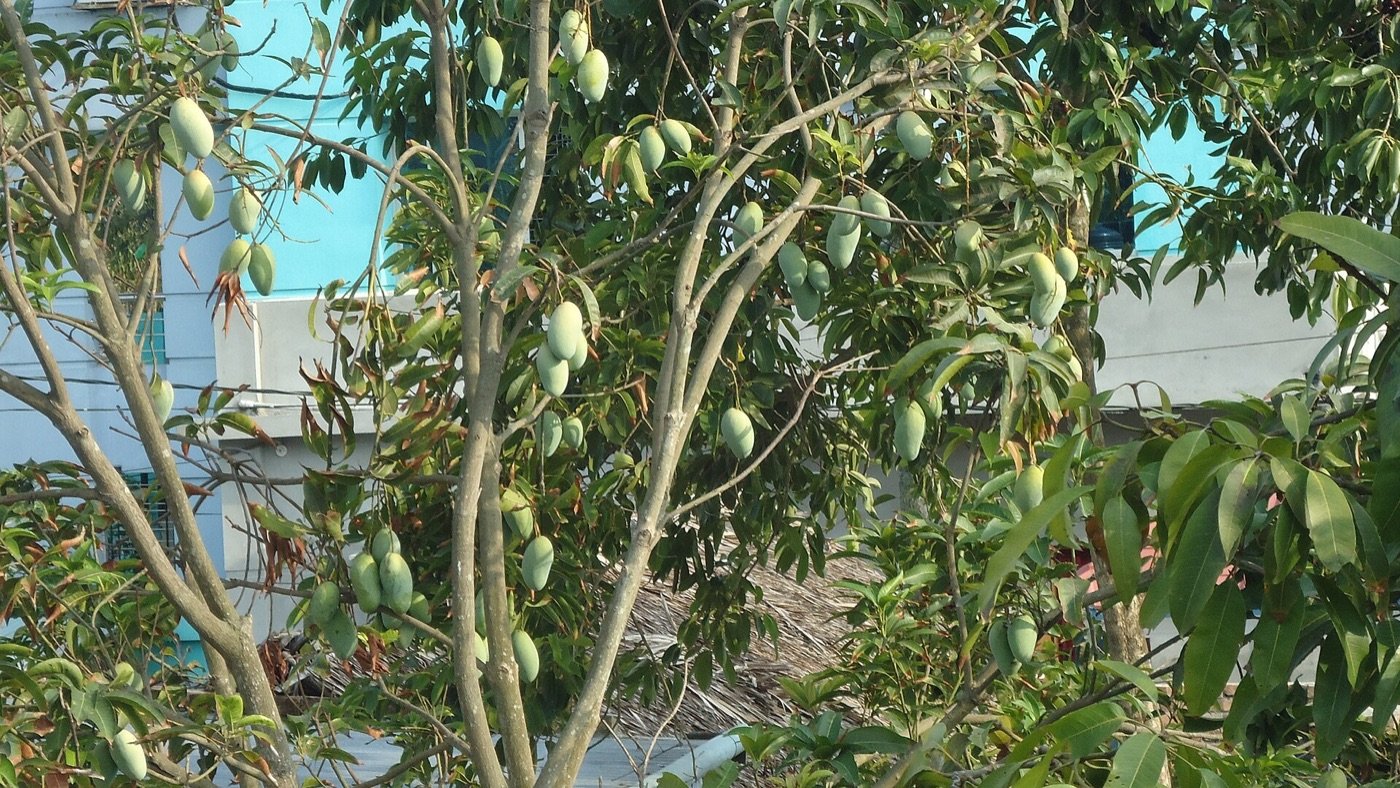
A mango tree with a lot of mangoes in Khulna, Bangladesh. Photo: Masum Ibn Musa, resized, CC BY-SA 4.0, via Wikimedia Commons.
I remember this from my own childhood. Around our home in the village, there were roughly forty mango trees, spread everywhere: one near the pukur, one behind the house, one in front of the courtyard and others along the paths. When I was eight, nine or ten, I would wake up around five-thirty or six in the morning and walk from tree to tree before the day became hot. The best discovery was a mango that had fallen naturally during the night. It felt like finding a small treasure that the tree had left for me.
No two mornings were exactly the same. One mango would be fragrant and soft; another would still be firm and sour; a third would have a different skin, shape or smell that I could recognise before I even tasted it. I did not need a lesson about biodiversity. I learned it by walking barefoot between the house and the pond, looking down at the grass.
Later, when I left the village and moved to the city, I was living roughly 29 kilometres away. My mother still lived in the village, while I stayed at my maternal grandparents’ home. The distance changed my mornings, but it did not end the mango season. My mother would send mangoes by car in quantities that sound almost unbelievable now: 70 kilos, 80 kilos, sometimes 100 kilos at once.
We did not put all of them in a refrigerator. The mangoes arrived in bags and were kept at home, where they ripened gradually over almost a month. Every day I opened the bags and checked them one by one. Which mango had softened? Which one was fragrant? Which one needed another day? The ripe ones disappeared first, usually into my hands and then into my mouth.
That daily inspection was its own kind of happiness. It made the season feel endless. We were not buying one or two fruits for an evening; we were living beside a slow-moving harvest. The house smelled different as the days passed, and every morning brought a new answer from the bags.
At that time, around twenty-five or thirty years ago, we paid about 20 taka per kilo in the village. In the rough comparison I remember, that felt like around two Swedish kronor per kilo. I do not present that as a precise historical exchange rate; what matters is the scale of the memory. The mangoes could feed a family through the season without costing what a single shopping trip can cost today.
Now I live in Sweden, and I often pay somewhere between 70 and 120 kronor for a kilo, depending on the shop, the variety and the season. Sometimes I look at the price and think: when I was a child, my mother could send more mangoes than we could count, and the whole season still cost less than a small bag here. That is not only a story about money. It is the story of how far I have travelled from the trees.
The village children are part of the mango season too. Their excitement is not a side story; it is one of the sounds of summer.
Not every mango in Bangladesh is grown for a shop or a truck. Many grow beside homes, ponds and paths, where the harvest belongs first to the family. Some are eaten fresh, some are dried, some become achar, and some are passed to neighbours in a metal bowl. A family may sell the best-looking fruit and keep the bruised or very ripe fruit for juice, mash or sharing. Nothing is judged only by appearance.
This is why the mango is tied so closely to ordinary life. It appears when relatives visit, when a neighbour returns a favour, when children come home from school and when a family wants to send a taste of the village to someone living in the city. The fruit moves through Bangladesh not only as a commercial product, but as a gift, a promise, a memory and sometimes a small part of a household’s income.
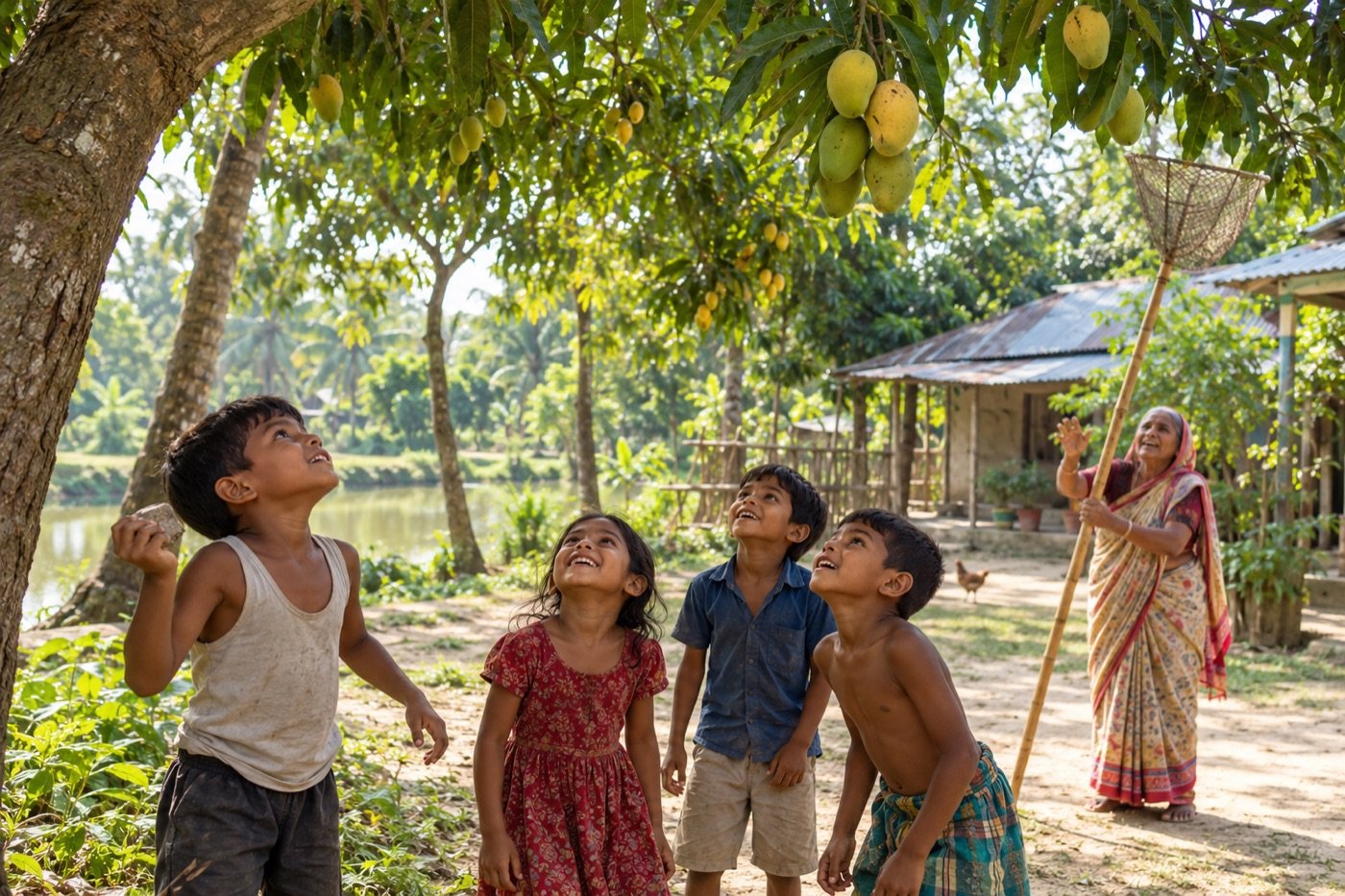
Children watching mangoes in a Bangladeshi village orchard while an elder prepares a safer harvesting method. AI-generated editorial illustration.
When a mango hangs above the water, harvesting becomes a small village expedition. An adult may reach with a long bamboo pole fitted with a hook or a small net. If the bank is safe, someone can stand beneath the branch; if the tree grows farther over the pond, a narrow boat or a careful reach from the edge may be needed. Sometimes ripe fruit drops into the water and has to be gathered quickly before it drifts away. The method changes with the tree, the pond and the people nearby.
Here is the picture many outsiders never imagine: a pond reflecting green leaves, mangoes hanging above the water and a farmer stretching a bamboo pole towards the branch. The harvest is part farming, part timing and part local knowledge.
And then there are the children. During mango season, a high branch can become an irresistible target. Children sometimes throw small stones or clods of earth to knock down a mango, shouting when one finally falls. It is a familiar village memory, full of excitement and competition, although grown-ups know that stones can bruise the fruit, break branches or hurt someone below. The safer tradition is a bamboo pole, a net or waiting patiently for the mango to fall.
When the Mango Becomes a Business
The village tree and the commercial orchard are related, but they are not managed in the same way. A tree beside a house may have grown from a seed and produce fruit that is unique to that place. A commercial orchard usually begins with a chosen variety and a grafted plant, so the new tree carries the characteristics of the mother plant. That is one reason commercial mangoes look more uniform than the mixed fruit found around village homes.
Uniform does not mean artificial. Growers create consistency through selection, grafting, spacing, pruning, irrigation, nutrition and harvest timing. They may also use fruit bags or other approved protection to reduce insect damage, blemishes and pesticide contact. Bangladesh’s agricultural guidance discusses irrigation after flowering, pruning for light and air, pest management and fruit-bagging research. These are management techniques, not proof that every mango has been treated with hormones.
Plant hormones and growth regulators are a separate subject. In mango science, natural hormones help control flowering, fruit set and fruit drop, and some commercial systems in South Asia study or use regulated plant-growth products. It would be wrong to tell readers that Bangladeshi growers simply inject hormones to make every mango identical. The variety, grafting material, orchard design, weather and harvest rules usually explain much more of what a buyer sees.
A commercial grower is also managing a deadline. Fruit must be mature enough to travel but firm enough to survive sorting, crates and transport. District authorities sometimes publish staggered harvest dates to discourage immature picking and to protect the reputation of the crop. The small family tree does not need a shipping calendar; the orchard that feeds a market does.
A Market Full of Possibilities
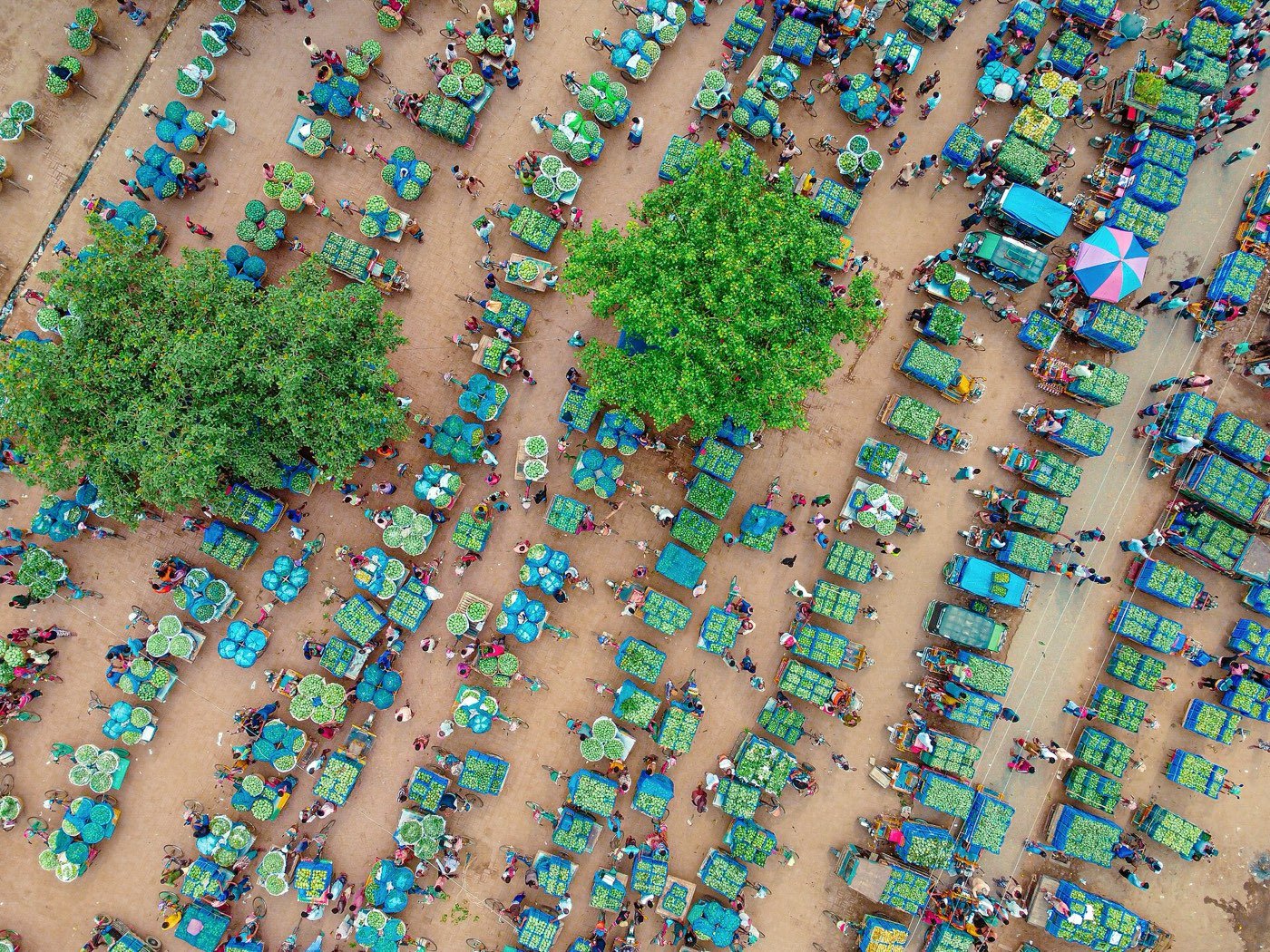
A traditional mango market in Chapainawabganj, Bangladesh, seen from above. Photo: Mahinur11, resized, CC BY-SA 4.0, via Wikimedia Commons.
The orchard gives way to the market, and the pace changes. Crates are opened, fruit is sorted and buyers lean forward to examine a batch. A purchase that seemed simple becomes a conversation.
Which variety? From where? Ready today, or better tomorrow? These are useful questions, and each answer changes what you take home. A box for a family gathering tonight is a different purchase from one intended to last several days.
The season itself arrives in chapters. Varieties mature at different times, while weather and location affect the sequence. The first arrivals create excitement; later ones give people something new to anticipate. Exact harvest dates vary, so a fixed calendar cannot replace information from the current harvest.
You may enter the market thinking that mango is one flavour. By the time you leave, that idea has become difficult to defend. There are names to remember and another variety you have been told to try next.
At a busy market, the best stories often begin with a disagreement. One buyer points to a box and says, “Those are ready today.” The seller lifts another mango and replies, “Wait until tomorrow.” A third person smells the stem and offers a completely different opinion. Nobody is in a hurry to end the argument. Mango season is long enough for everyone to be right on a different day.
To make that journey easier, here are six mangoes strongly associated with Bangladeshi markets and mango culture.
I am deliberately not assigning one decorative photograph to each name here. A mango’s appearance changes with ripeness, orchard and camera light, and a beautiful but wrongly labelled image teaches the reader the wrong lesson. The descriptions below are more honest: they tell you what to ask for, while the seller or grower confirms the identity.
Khirsapat is associated especially with Chapainawabganj and is recognised in Bangladesh as a GI product. It is usually aromatic, juicy and sweet, with flesh that is described as fibreless. Langra is another major name from the same broad mango region. Gopalbhog arrives earlier in the season in many harvest calendars. Fazli is late and large, often useful for sharing, preserving or making achar. Amrapali is a modern hybrid grown widely, while Haribhanga is strongly associated with Rangpur in the north.
These are not six interchangeable “yellow mangoes”. They ripen at different times, have different textures and carry different regional memories. That is why a Bangladeshi mango buyer asks not only, “Is it sweet?” but also, “Which mango is it, and where did it come from?”
One Fruit Many Growing Worlds
Mango is grown in roughly a hundred countries, but the largest production is concentrated in South and Southeast Asia. India is the world’s biggest producer and consumes most of what it grows. China, Indonesia, Thailand, Pakistan and Bangladesh are also major Asian producers. Mexico, Brazil and Peru are especially important in international trade, while Egypt has become a significant supplier for nearby markets.
The difference between producing and exporting matters. A country can grow enormous quantities and still export relatively little because families eat the fruit at home, local markets absorb the crop or the cold chain is limited. Bangladesh belongs to this story: mango is deeply consumed at home, while exporters must also solve grading, treatment, packaging, certification and transport.
Pakistan is famous for varieties such as Chaunsa and Sindhri; India has an extraordinary regional range including Alphonso, Kesar, Dashehari and many others; Thailand is known internationally for varieties such as Nam Dok Mai; Mexico is strongly associated with Ataulfo and Kent; Brazil and Peru supply long-distance markets; Egypt grows mangoes for regional and export trade.
Spain is Europe’s leading mango-growing country, especially in Andalusia, where a Mediterranean climate makes commercial production possible. Italy is a smaller and newer mango-growing country, with orchards expanding mainly in Sicily, Calabria and parts of southern Italy. These orchards are important, but their scale and climate are different from the vast seasonal mango landscapes of Bangladesh.
So where is the best mango? The honest answer is not a single flag. The best mango is the one that is the right variety, naturally mature, handled carefully and eaten at the moment its flavour is ready. Bangladesh has a special advantage that no export chart can measure: mango is not just an agricultural product there. It is part of the calendar, the family and the memory of home.
That is part of the adventure. A good purchase offers more than a bag of fruit: it gives you a reason to return, compare and discover what the next part of summer tastes like.
The King Wears More Than One Crown
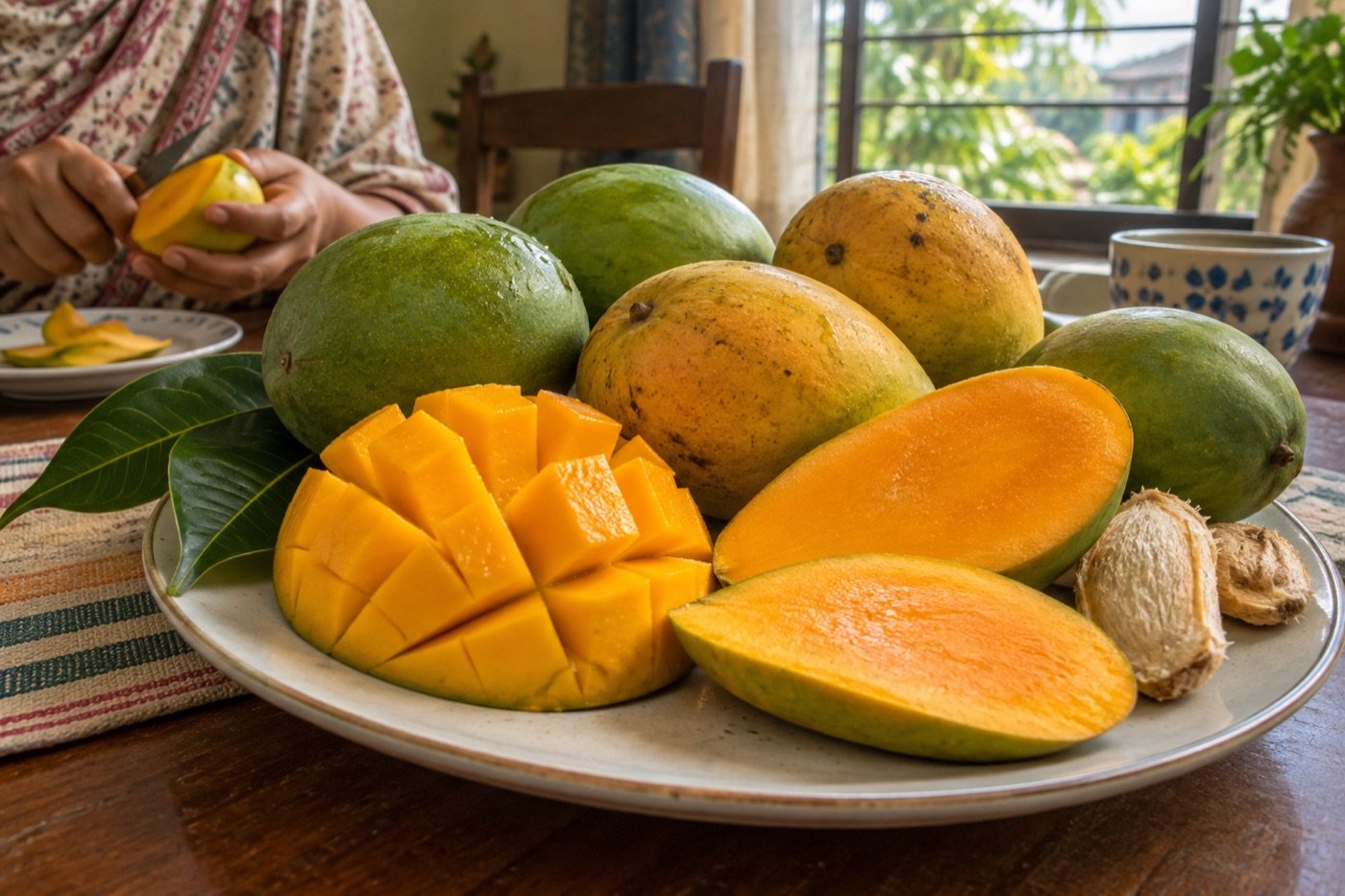
Green and yellow skins reveal golden flesh. Illustrative fruit, not a labelled variety comparison.
Ask several Bangladeshi mango lovers for a favourite and you may start the longest conversation of the afternoon. Langra, Khirsapat, Gopalbhog, Amrapali and Fazli are names worth learning. Haribhanga adds another northern connection to the discussion. This is an introduction, not a complete list.
These varieties are grown or enjoyed in Bangladesh; their inclusion does not mean that every one originated there or is exclusive to the country. Local spellings and market names can also vary, so ask a reliable grower or seller what you are buying.
One person wants a powerful aroma. Another prefers flesh that slices neatly. Someone else enjoys a softer texture and a little acidity beneath the sweetness. The most enjoyable response is to taste more than one, at a comparable stage of ripeness.
And here is a surprise for anyone who shops by colour: a green skin can hide a ripe mango. Colour alone is not a dependable guide. Gentle pressure and, sometimes, fragrance near the stem offer more useful clues.
Cut carefully around the broad, flat stone. The flesh opens into golden cheeks, and the outside of the fruit suddenly seems less important. Taste before adding anything. Notice the aroma, texture and balance. Then take another piece before deciding which mango deserves your crown.
In many homes, choosing a favourite becomes a friendly competition. A plate is prepared without announcing the names. Family members taste one piece, then another, trying to guess which is Langra, which is Khirsapat and which one has the richest perfume. The winner is rarely unanimous. That is exactly why the game is worth playing.
The Bowl That May Surprise You
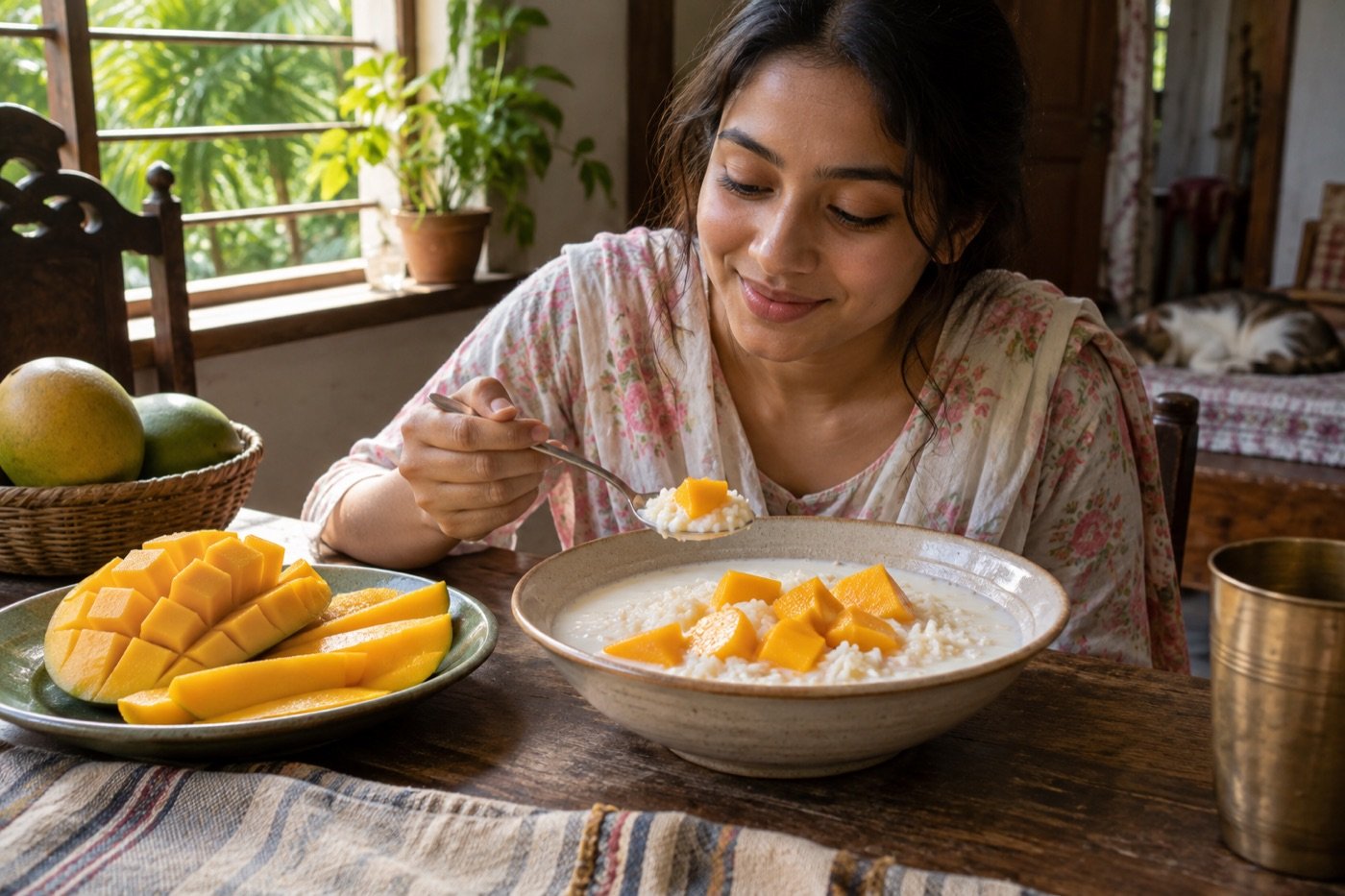
Rice, milk and ripe mango: a simple Bengali home combination. AI-generated illustration.
Back at home, the journey takes an unexpected turn. Mango is not always saved for a separate dessert. It can join rice and milk in a bowl: aam, dudh and bhat.
The combination is familiar in Bengali food culture on both sides of the border. Families prepare it differently, but the attraction is easy to understand. Ripe mango supplies fragrance and sweetness, milk softens the mixture, and rice makes it substantial.
For a simple first taste, put a small serving of freshly cooked rice, allowed to cool briefly, into a bowl. Add milk and pieces of ripe mango, then mix to the texture you enjoy. Eat promptly. There is no need to add sugar before tasting the fruit.
Some people prefer everything thoroughly mixed. Others leave pieces of mango waiting between spoonfuls. This is home food, and its pleasure does not depend on precise restaurant presentation.
A grandmother may remember the dish from a time when the mangoes came from the tree behind her childhood home. A younger child may only know that the bowl tastes like summer. Between them, the recipe travels quietly from one generation to the next.
There is room for an even simpler experience too: a plate of sliced mango passed around the table. Someone will claim the flesh around the stone. Juice may reach the fingers. The fruit does not need perfect manners to make a memorable impression.
But slicing is not the only way Bangladeshi people enjoy it. When a mango is perfectly soft, many people make a small opening at the tip, squeeze the fruit gently and drink the juice directly from the skin. The mango becomes its own glass. This is often called eating the mango by sucking or drinking it, and it is wonderfully messy: the peel collapses in the hand, the juice runs down the fingers and the stone is saved for the last sweet pull. No knife, no plate and no ceremony—just the fruit, the summer air and a happy face.
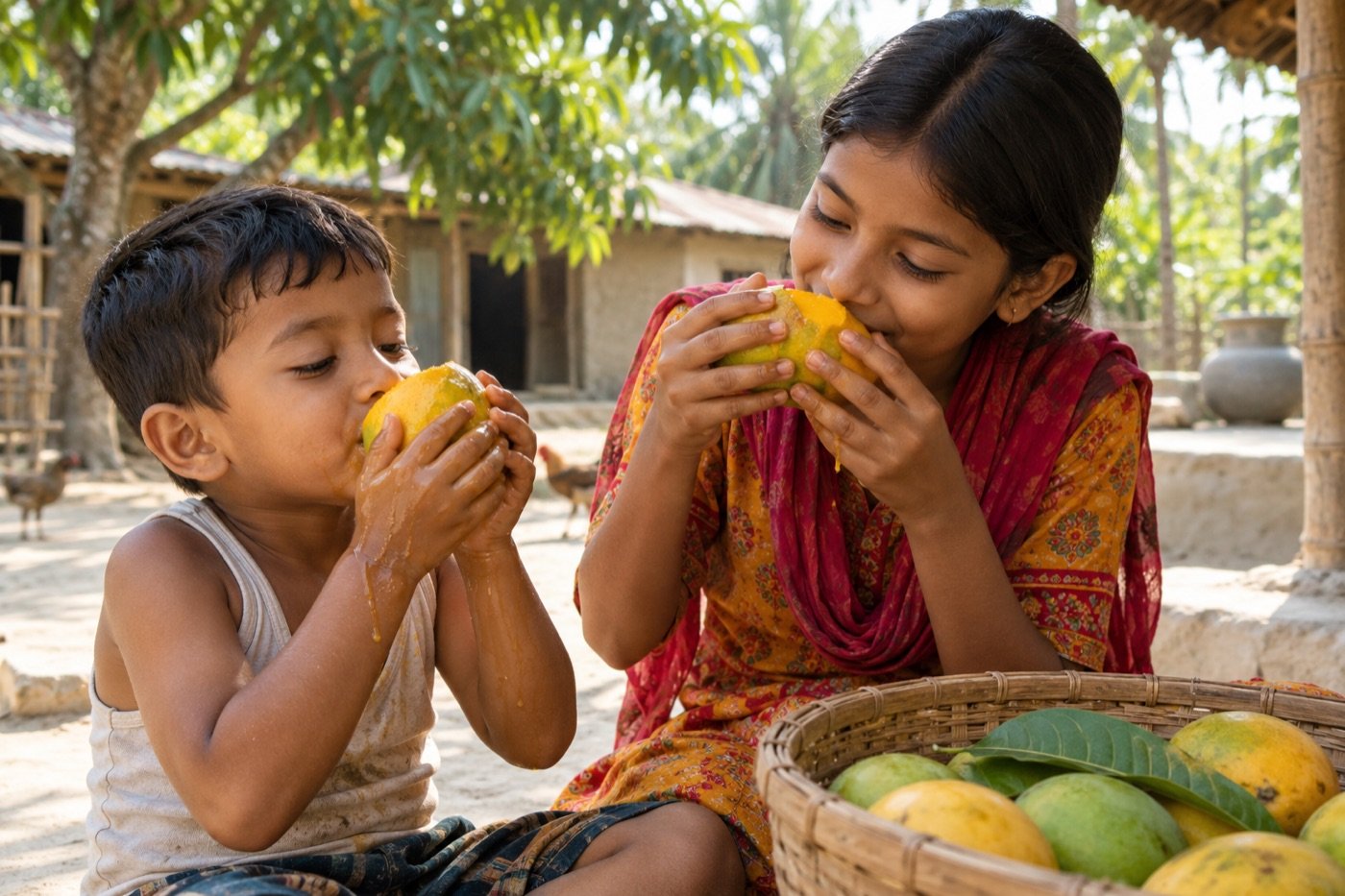
Eating a ripe mango directly from the fruit in a rural Bangladeshi courtyard. AI-generated editorial illustration.
That way of eating says something important about rural life. Food is not always arranged for a photograph. It is shared on a veranda, under a tree, beside a pond or after returning from the fields. A child may finish a whole mango with both hands sticky, while an older person tells them which variety they have just tasted. The lesson is practical, affectionate and delicious.
Before the Gold Comes the Green
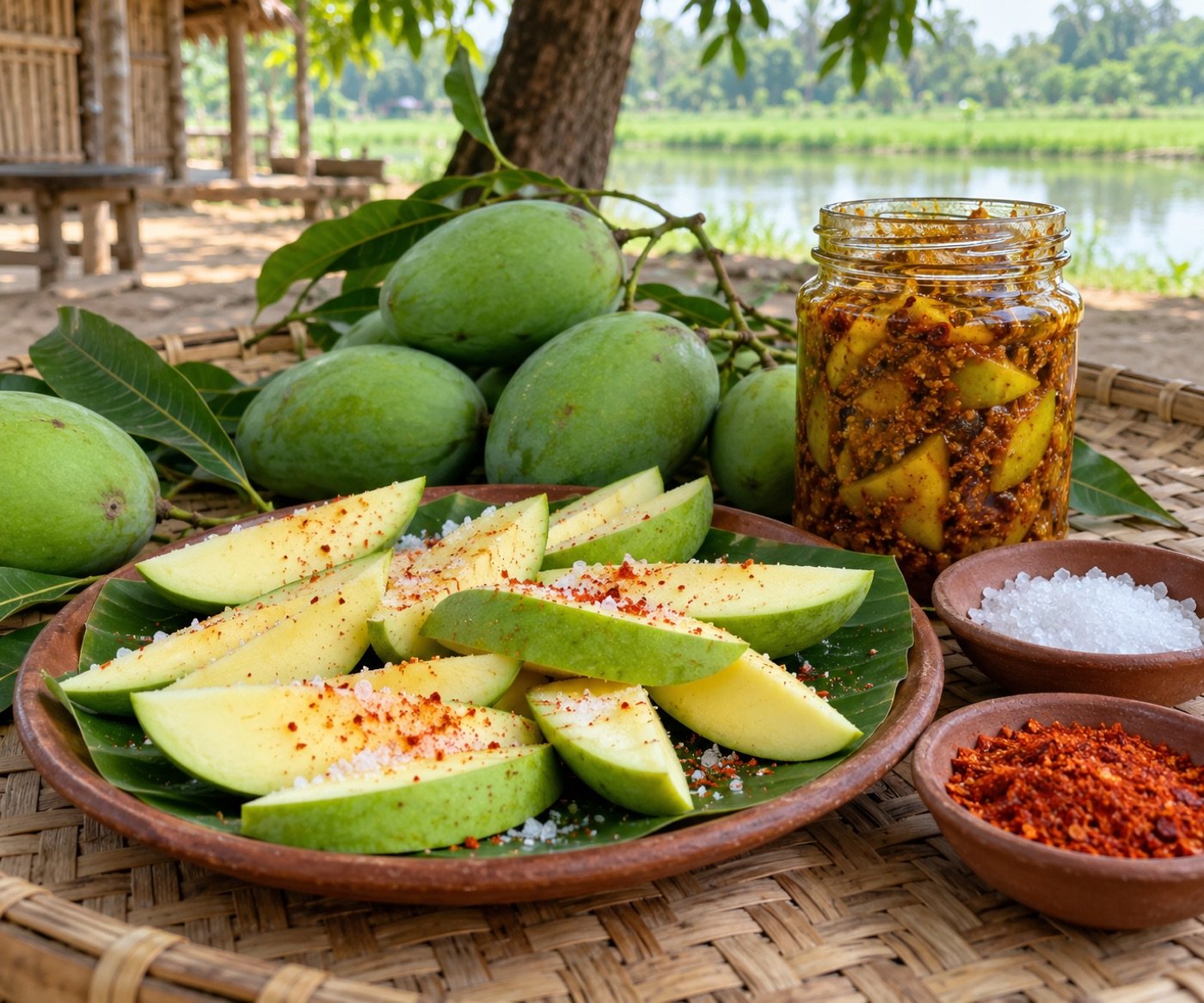
Green mango, salt and chilli beside mango achar. AI-generated illustration.
Until now, the king has shown a generous, sweet side. Green mango introduces a sharper personality. Its firm flesh and sourness create a different kind of appetite: the sort that wakes up with the first bite.
Try thinking of green mango as an ingredient in its own right. With salt and chilli it becomes a lively snack. In chutneys, drinks and pickles, acidity gives the preparation its direction. For these uses, waiting for the fruit to turn sweet would miss the point.
Then comes aam achar. Open a jar and the story shifts again. Mango pickle may be hot, sour, sweet, or a combination of these, depending on the recipe. A small spoonful beside rice and dal can change the whole mouthful.
Household recipes and commercial preparations differ, so read the description before choosing a jar. Follow its storage directions after opening. Start with a small spoonful beside your meal, then discover whether you prefer a sweeter preparation or one with a sharper bite.
The fresh season eventually ends, but achar offers another way to keep enjoying mango. For someone far from Bangladesh, it can be a welcome companion at the table: familiar, vivid and ready to turn a simple meal into something more interesting.
There is a special kind of homesickness in opening a jar of achar abroad. The first smell does not merely suggest mango; it suggests a courtyard, a metal bowl, a neighbour calling from across the fence and rain on a tin roof. A spoonful cannot reproduce an entire village, but it can open the door to a memory.
The Chutney Table
Mango does not have one final form in a Bangladeshi kitchen. It can become a pickle, a drink, a mash or a chutney, and each word carries a slightly different mood. Achar is usually salted, spiced and preserved in oil or brine so it can wait. Chutney is often cooked down and eaten sooner, while the flavour is still bright. In real homes the boundaries can overlap, and family names do not always follow a single rule.
The most familiar Bengali direction is aamer chutney: semi-ripe or green mango cooked with sugar or jaggery, salt, ginger and a tempering of panch phoron, the five-spice blend that can include fenugreek, nigella, cumin, fennel and mustard. Some cooks add a dried chilli. Others add lemon, tamarind or a little vinegar. The result may be glossy and sweet-sour, with soft pieces of mango, or sharper and more savoury. It is often served near the end of a meal, after rice and dal, as if the kitchen is saying: do not leave yet; there is one last taste.
Then there is the green, lively chutney made almost to order: raw mango with chilli, salt, coriander, mustard or mint. It can be coarse, pulsed or completely smooth. One household may make it hot enough to make everyone reach for water; another may let sugar soften the sourness. In Bangladesh, a recipe like this is rarely just a list of measurements. It is a memory carried in the hand that stirs.
Ripe mango gives the chutney another personality. Its flesh can be cooked with ginger, chilli, sugar or jaggery and an acidic note from lemon, tamarind or vinegar. The texture may stay chunky, or be reduced to a thick, spreadable sauce. Outside South Asia, this is the style many people recognise as “mango chutney”, served with samosas, fried snacks, grilled food, sandwiches or cheese. The global version is useful, but it should not replace the Bengali table where chutney is also part of the rhythm of a meal.
If you want to taste the range without making a large batch, try three small bowls: green mango with salt and chilli; semi-ripe mango with jaggery and panch phoron; and ripe mango with ginger, chilli and lemon. Same fruit, three different stories. The first wakes you up, the second settles beside rice, and the third follows you towards dessert or a piece of bread.
That variety is why I would never write “mango chutney” as though it were one fixed product. It may be sweet, hot, sour, smoky, chunky or smooth. It may be the work of a grandmother measuring by instinct, a village shop filling jars for neighbours, or a modern producer balancing sugar and acid for a longer journey. The mango changes, but so does the person standing beside the pot.
A Gift with a Delicious Deadline
A box of mangoes is a gift with a gentle urgency. It cannot sit forgotten on a shelf. It asks to be opened, checked and enjoyed while the fruit is good.
That is part of its charm. Sharing mangoes with friends and family carries a straightforward message: I found something worth tasting, and I wanted you to have some. The variety and source become part of the conversation. So does the question of which fruit is ready first.
If you give a box, include the variety name and what the seller has told you about ripeness. A mixed selection can become a tasting, provided the recipient knows which fruit is which. There is no need to promise that one variety is the best; let the table decide.
Outside Bangladesh, ask specialist South Asian shops or seasonal importers about clearly identified Bangladeshi fruit. Confirm origin, variety, arrival date and expected ripeness. A South Asian shop may stock mangoes from several countries.
For readers in Sweden, check current availability and delivery arrangements before planning a gift or gathering. Compare the price per kilogram, shipping cost and damaged-fruit policy. The right box is one that arrives with its flavour, and its identity, intact.
Imagine the journey of one mango: picked before it is fully soft, carried from a village collection point to a wholesaler, placed in a shipment and finally opened in a kitchen far away. By the time it reaches Sweden, the fruit has crossed more than kilometres. It has carried a season, a language and the patience of the people who waited for it to ripen.
Bring the Adventure to Your Table
When your mangoes arrive, inspect the box and separate the ripest fruit. Keep unripe mangoes at room temperature, checking them regularly. Refrigerate ripe fruit to slow further softening; keep cut mango covered in the refrigerator. Different fruit in the same box may be ready on different days.
For an easy serving idea, spoon plain yoghurt into two bowls and divide the flesh of one ripe mango between them. Taste before adding sweetener. A small pinch of cardamom is optional. This is a serving suggestion, not a claim to a particular traditional recipe.
Better still, arrange two varieties on separate plates and invite someone to taste with you. Talk about fragrance and texture, not only sweetness. If you disagree about the winner, you have a reason to try again.
Calling mango the king of fruits is easy. Understanding its place in Bangladesh means following a season, learning a few names and noticing the people who bring the harvest to the table. The crown is an affectionate title, not a claim that mango belongs to Bangladesh alone.
Our journey ends where it began: a box on a table, plates being fetched, and something good to share. Someone cuts the next mango. Conversation pauses for a taste. Then, inevitably, someone suggests another variety. The adventure has another chapter.
Outside the window, the evening settles over the village. The pukur becomes a dark mirror. A few mangoes remain in the basket, and the tree is almost silent again. Tomorrow, someone will check the fruit above the water, someone will argue about the best variety and someone will call the children away from the stones. The king has not left; it has simply returned to the tree.
— Imran Hossain
Sources:
- National Mango Board — ripening and storage guidance
- Banglapedia — Fruit and the place of mango in Bangladesh homesteads
- Banglapedia — Mango Research Station at Chapainawabganj
- Bangladesh Agricultural Research Institute — mango variety research
- FAOSTAT — global food and agriculture data
- OECD FAO Agricultural Outlook — global mango production
- BSS — Bangladesh harvest calendar by variety
- BAMIS — Bangladesh mango cultivation guidance
- CBI — mango varieties and European import market
- Khirsapat mango — background and naming discussion
- Haribhanga mango — regional background
- Bong Mom’s CookBook — Bengali mango, milk, rice and yoghurt food memories
- Bengali-style mango chutney — semi-ripe mango, ginger and panch phoron
- Bengali raw mango chutney — aamer chutney
- Chutney styles and common ingredients in Bangladesh
- Raw mango chutney ingredient guide
The article combines the author’s personal memories with reported agricultural and historical information. The three photographs are credited under their captions and used under free licences. The other pictures are AI-generated editorial illustrations and are not presented as documentary photographs of a named Bangladeshi farm.