A Food Journey From the Slopes of Vesuvius: Pomodorino del Piennolo del Vesuvio PDO
The little tomato born beneath a volcano that learned to defy time
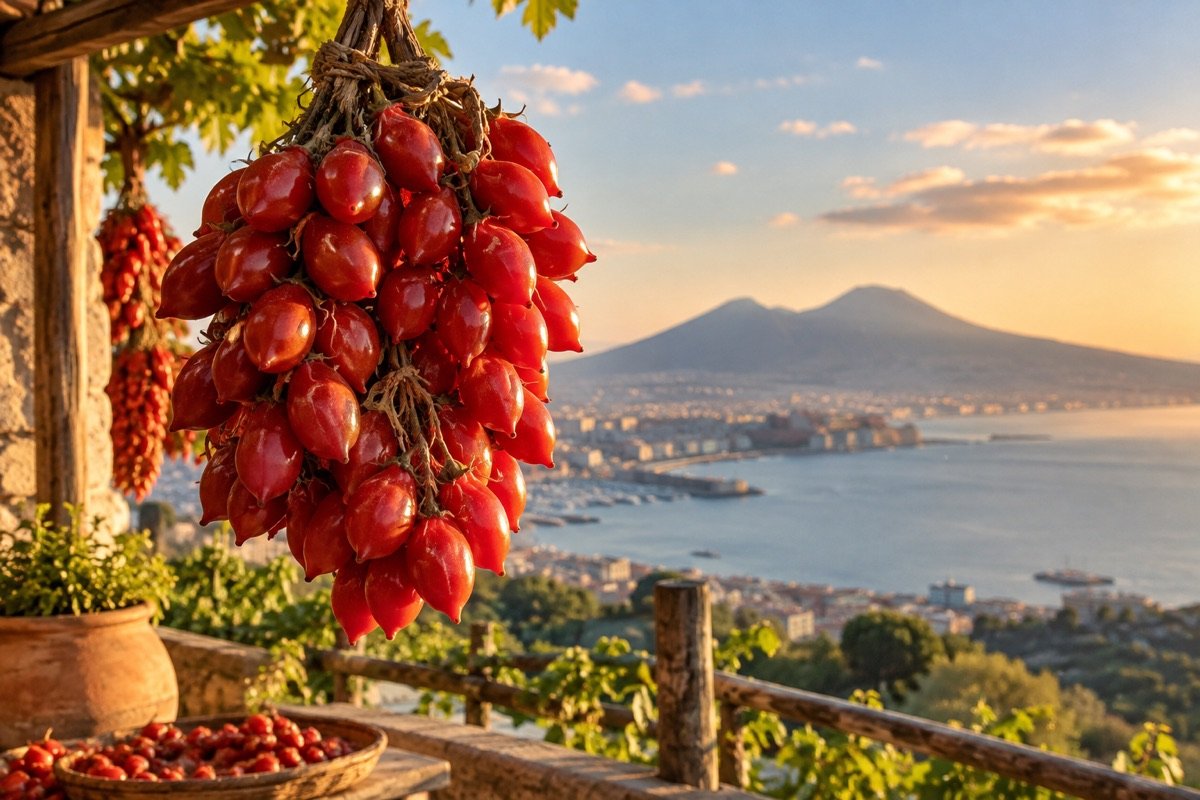
A traditional Piennolo, suspended between volcanic land and the Bay of Naples.
Some foods are simply eaten. Others begin telling you a story before they ever reach your plate.
The Pomodorino del Piennolo del Vesuvio PDO belongs unmistakably to the second kind. To understand it, you have to forget perfect supermarket packaging for a moment and travel south, toward Naples. Leave the city behind. Climb through small towns, old houses, orchards and vegetable gardens until the soil under your feet turns dark and the silhouette of Vesuvius fills the horizon.
The landscape is beautiful, but it also carries a quiet reminder: this is land shaped by a volcano. That volcanic ground, the Mediterranean sun and generations of practical knowledge come together in one small, pointed tomato with a remarkably intense personality.
This is the story of how a humble fruit became a symbol of place, patience and preservation — and why it deserves far more attention than its size suggests.
Chapter 1 — A Tomato Born on Volcanic Land
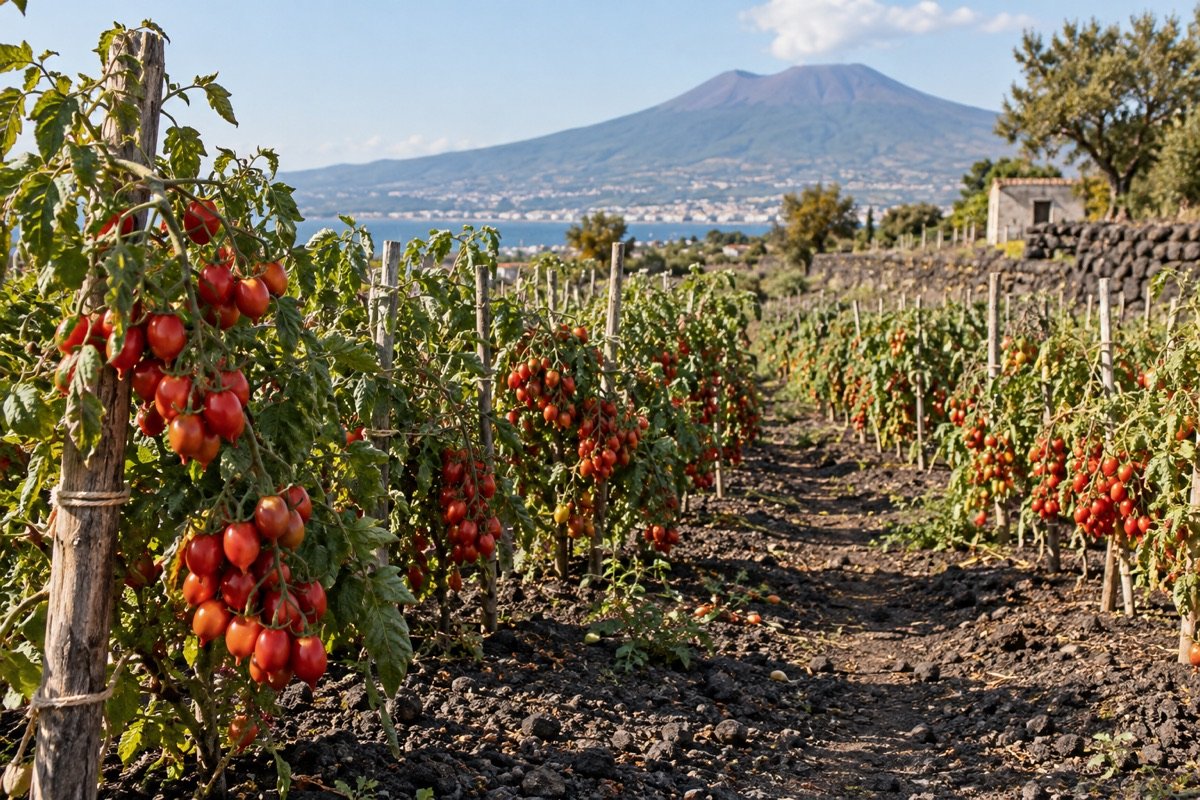
Piennolo tomato plants on the volcanic slopes of the Somma Vesuvius complex.
At first glance, it may look like another small red tomato. Look again. The fruit is oval or slightly plum-shaped, often ending in a pointed tip. Its skin is firm, its attachment to the stem is unusually strong, and its flavour balances sweetness with a lively acidity.
The protected production area lies in the province of Naples around the Somma-Vesuvius volcanic complex. The official specification links the tomato's character to dry growing conditions, generous sunlight, strong day-to-night temperature changes and soils formed from volcanic material.
That matters because PDO does not describe a style that can be copied anywhere. It protects a relationship between product, method and place. The same type of seed grown elsewhere may still produce a good tomato, but it cannot reproduce the complete combination that the name Pomodorino del Piennolo del Vesuvio PDO is meant to guarantee.
Here, the territory is not merely the background to the story. It is one of the ingredients.
Chapter 2 — Why It Is Called Piennolo
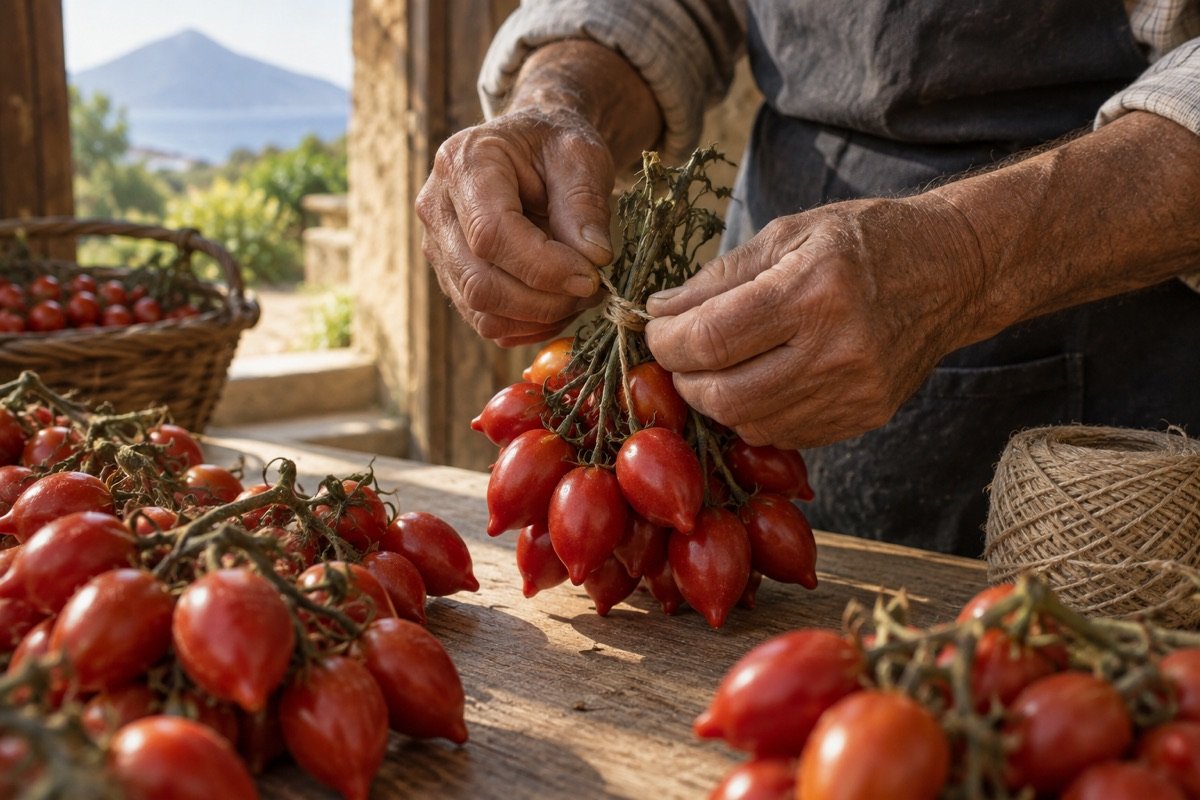
The name Piennolo is inseparable from the patient work of gathering and suspending the clusters.
This is perhaps the most beautiful part of the story. The name Piennolo is connected to the traditional practice of gathering tomato clusters and suspending them together.
Imagine dozens of small tomatoes still attached to their stems. The harvested clusters — known locally as schiocche — are arranged around a ring of plant fibre until they form one much larger hanging bunch. The finished structure resembles a natural red chandelier.
It is visually spectacular, but the method was not invented for decoration. It answered a practical question that families had faced for centuries: how could summer tomatoes remain available during the colder months?
The answer was to work with the tomato's own strengths rather than fight against them. Strong skin, a tenacious stem and a carefully ventilated environment made hanging preservation possible.
Chapter 3 — The Refrigerator Before Refrigerators
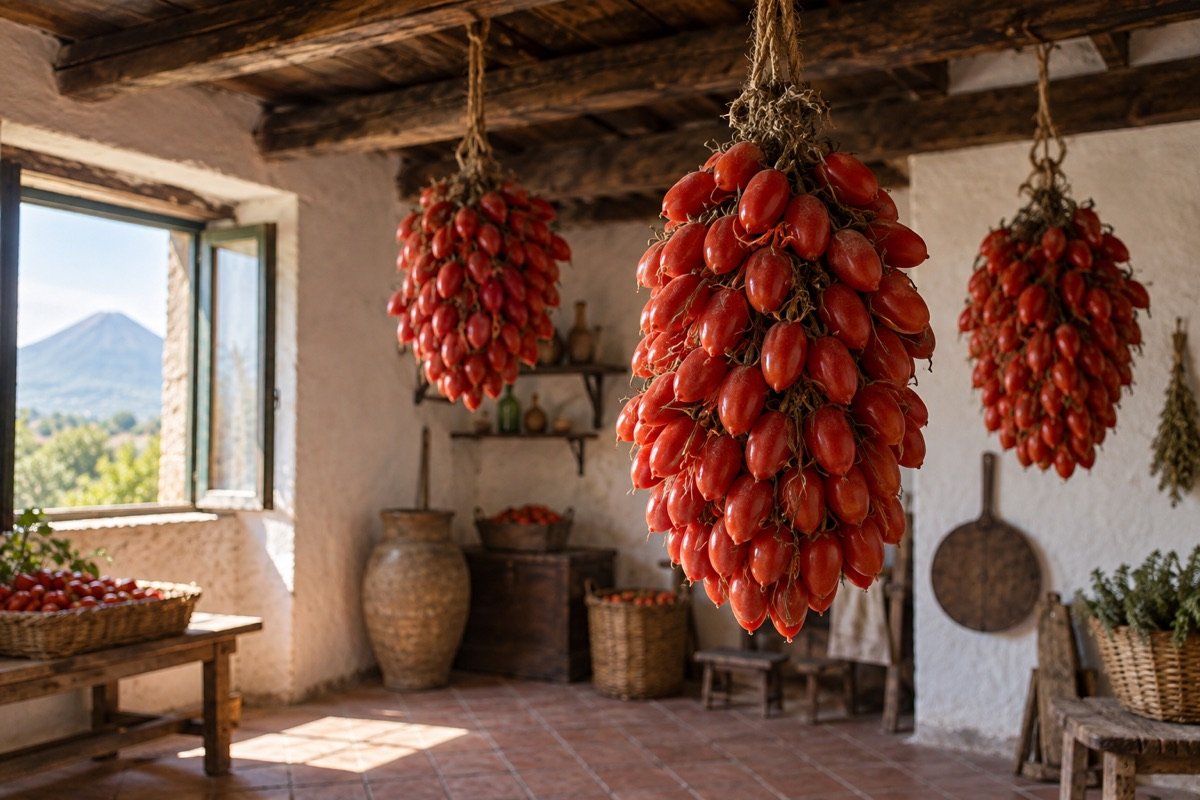
Suspended in a dry, ventilated room, the Piennolo becomes a traditional form of winter preservation.
Travel backwards to a kitchen without refrigeration, controlled atmosphere or modern cold storage. Summer ends, but pizza, pasta and everyday cooking still need the brightness of tomato.
Families around Vesuvius relied on the Piennolo. Once formed, the large bunch was kept off the ground in a dry, ventilated place. The official production rules still describe this method and prohibit chemical treatments during storage.
Time does not leave the tomato unchanged. Moisture slowly decreases, the skin may wrinkle and the flavour becomes more concentrated. That is not a failure of preservation. It is part of the ingredient's evolution.
The production specification cites documented accounts from the late nineteenth and early twentieth centuries and explains why the method became so valuable: it allowed households to keep flavourful tomatoes for winter dishes long after the summer harvest had ended.
Tradition in Miniature
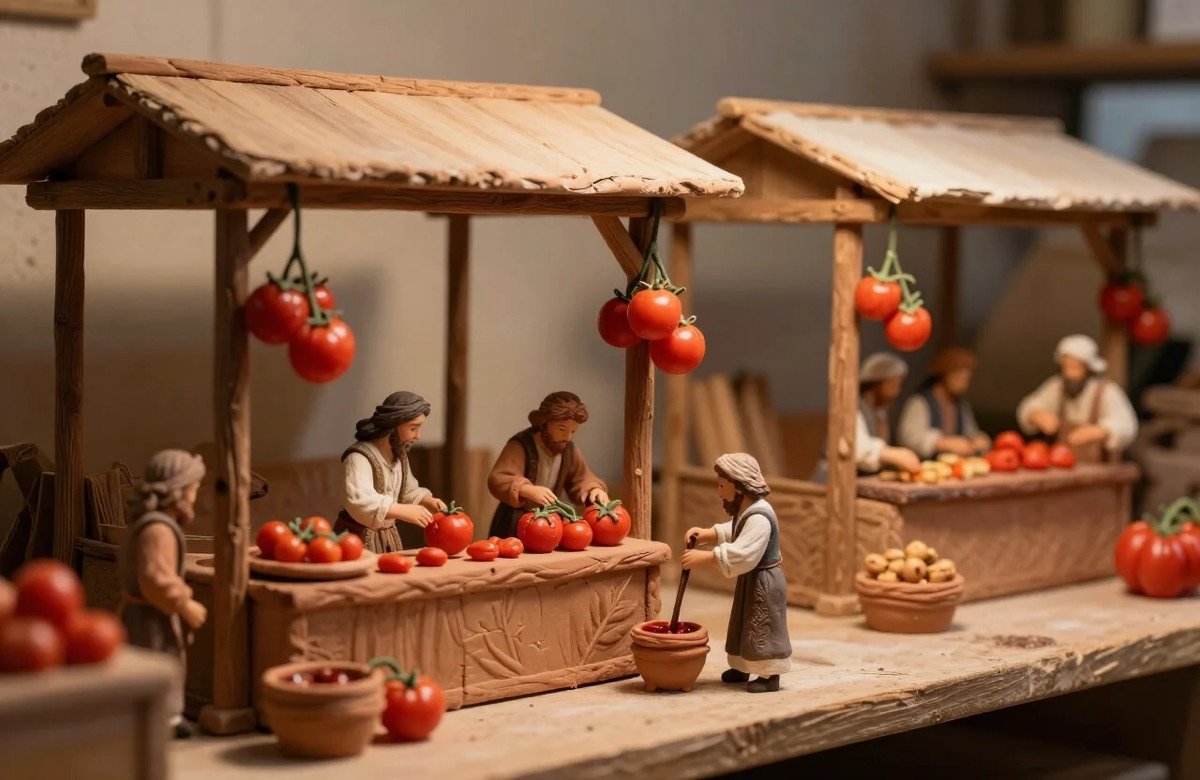
A miniature market scene with hanging tomatoes and handcrafted figures, evoking the atmosphere of a traditional Italian market.
Chapter 4 — Everything Begins with the Harvest
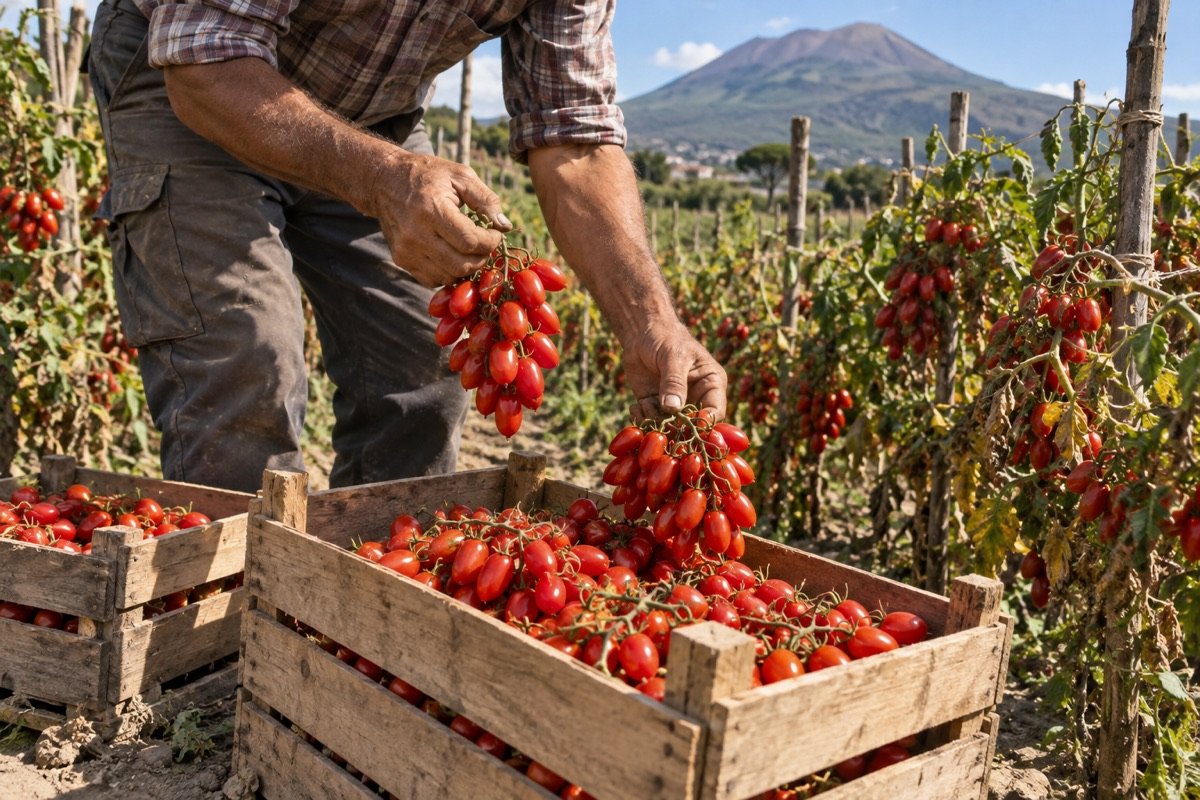
The protected tomatoes are harvested by hand in intact, healthy clusters.
Before there is a hanging Piennolo, there is a plant growing in open volcanic ground. There is heat, wind, sun and the work of the farmer.
The PDO specification recognises traditional ecotypes associated with names such as Fiaschella, Lampadina, Patanara, Principe Borghese and Re Umberto. It excludes hybrids and requires open-field cultivation. The tomatoes are harvested by hand during the summer harvest period defined in the production rules.
Fresh protected fruit must be small: no more than 30 grams. It should have high firmness, vermilion skin, red flesh, a lively sweet-and-acidic taste and a strong attachment to the stem.
Small in size, certainly. Small in character, never.
Chapter 5 — How a Piennolo Is Made
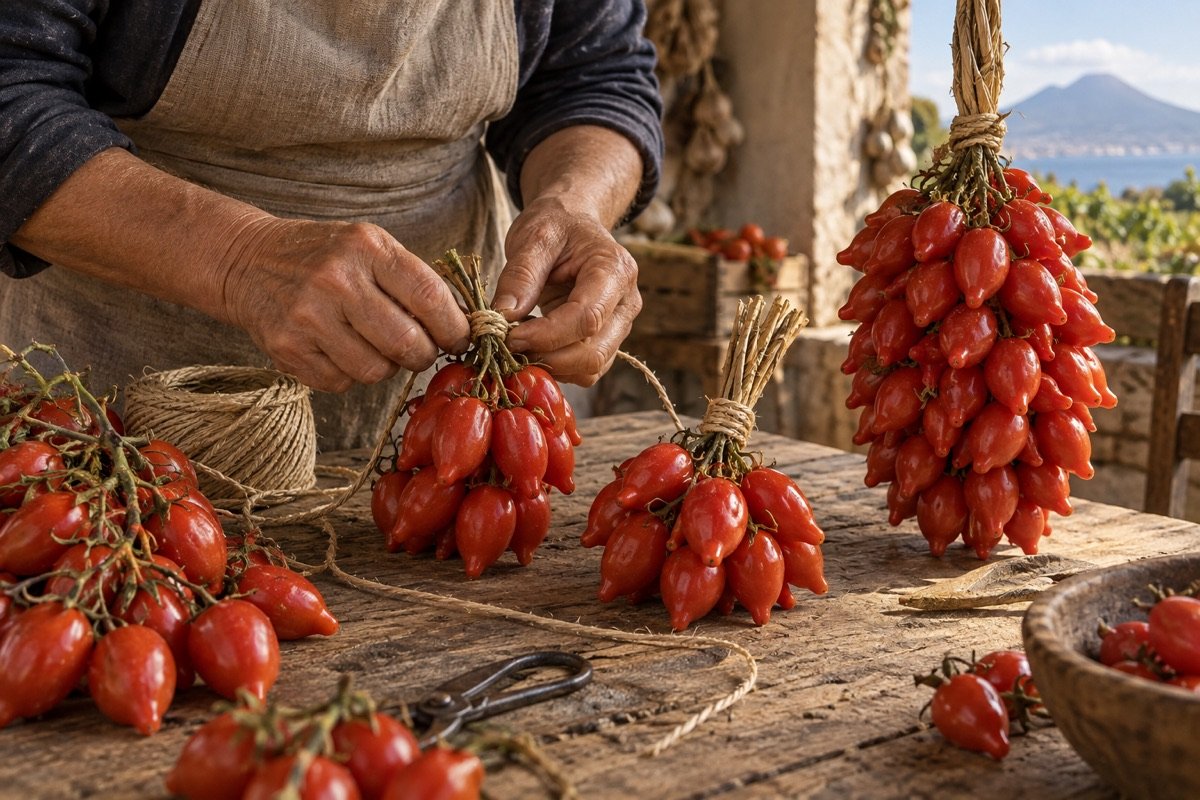
Loose clusters are gradually built into a single Piennolo using natural fibre.
After harvesting comes the stage that turns produce into a recognisable cultural object. The clusters are selected, handled carefully and arranged one after another around a ring of plant fibre.
The work rewards patience. A weak stem can release a tomato. A damaged fruit can reduce keeping quality. The person assembling the Piennolo therefore reads each cluster with experienced hands, deciding where it belongs and how it should sit.
According to the official rules, a finished Piennolo weighs between one and five kilograms at the end of storage. It is then suspended from hooks or placed on suitable supports in a dry, ventilated location.
Agriculture, necessity and beauty become almost impossible to separate. The object is useful because it is carefully made, and beautiful because every part of it still reveals the fruit, the stem and the hand that arranged it.
Chapter 6 — The Secret Is Also in the Skin
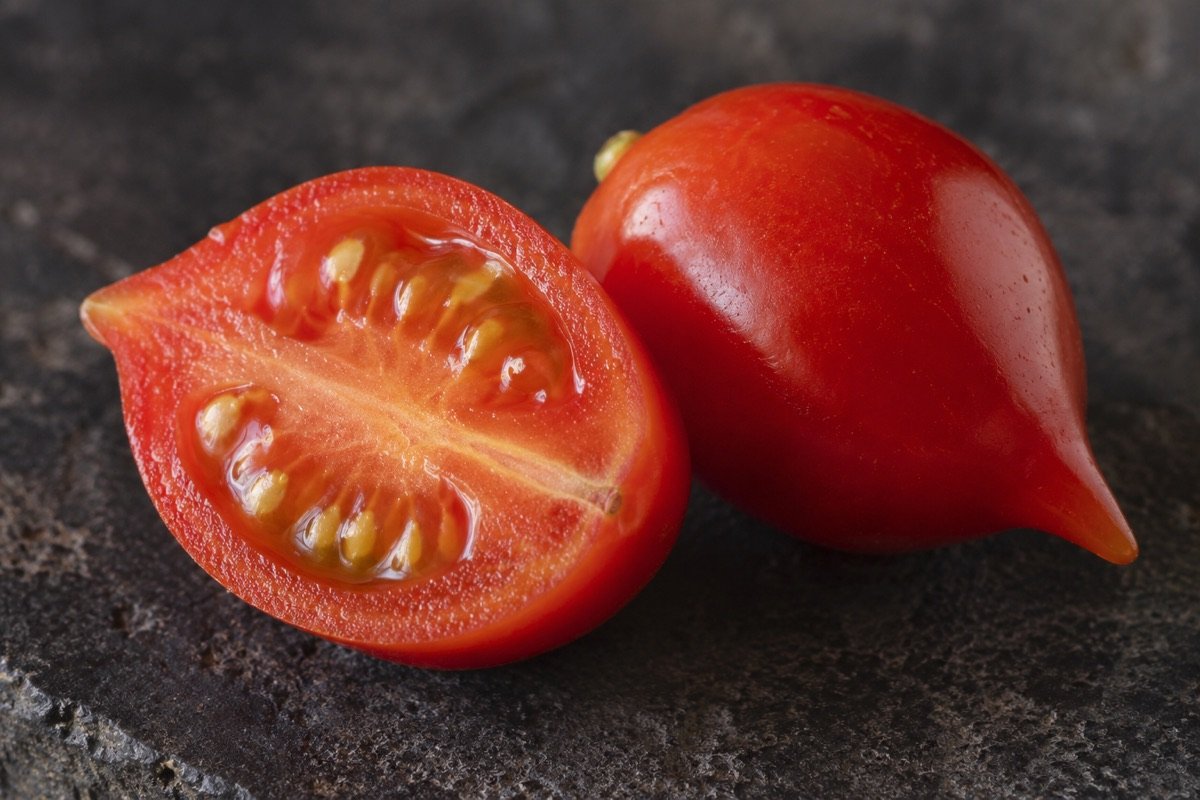
Firm skin, dense flesh and a lively sweet acidic profile help give the tomato its distinctive character.
Cut one open and you immediately see that this is not a watery, anonymous tomato. The skin is firm. The interior is juicy but concentrated. The aroma arrives quickly, followed by sweetness and a bright acidic edge.
Its keeping ability comes from a combination of characteristics rather than one magical property: strong skin, firm attachment to the stem, and a high concentration of sugars, acids and other soluble solids. The dry volcanic soils and the local growing conditions help shape those qualities.
For a cook, the most important conclusion is wonderfully simple: the tomato already brings structure and intensity. It does not need a long list of ingredients to become interesting.
Sometimes the most respectful way to cook an exceptional ingredient is to do less.
The Distinctive Pointed Tip
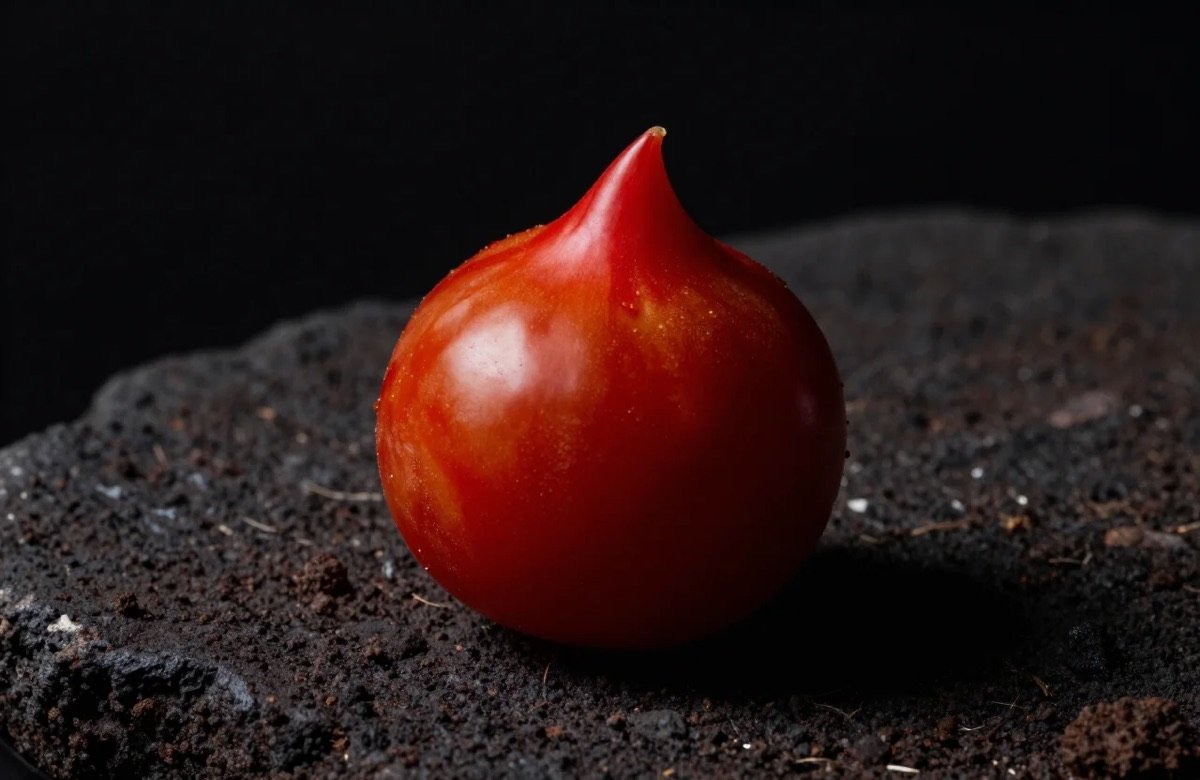
A close view of the pointed tip and glossy red skin, set against the dark texture of volcanic stone.
Chapter 7 — My Favourite Way to Discover It
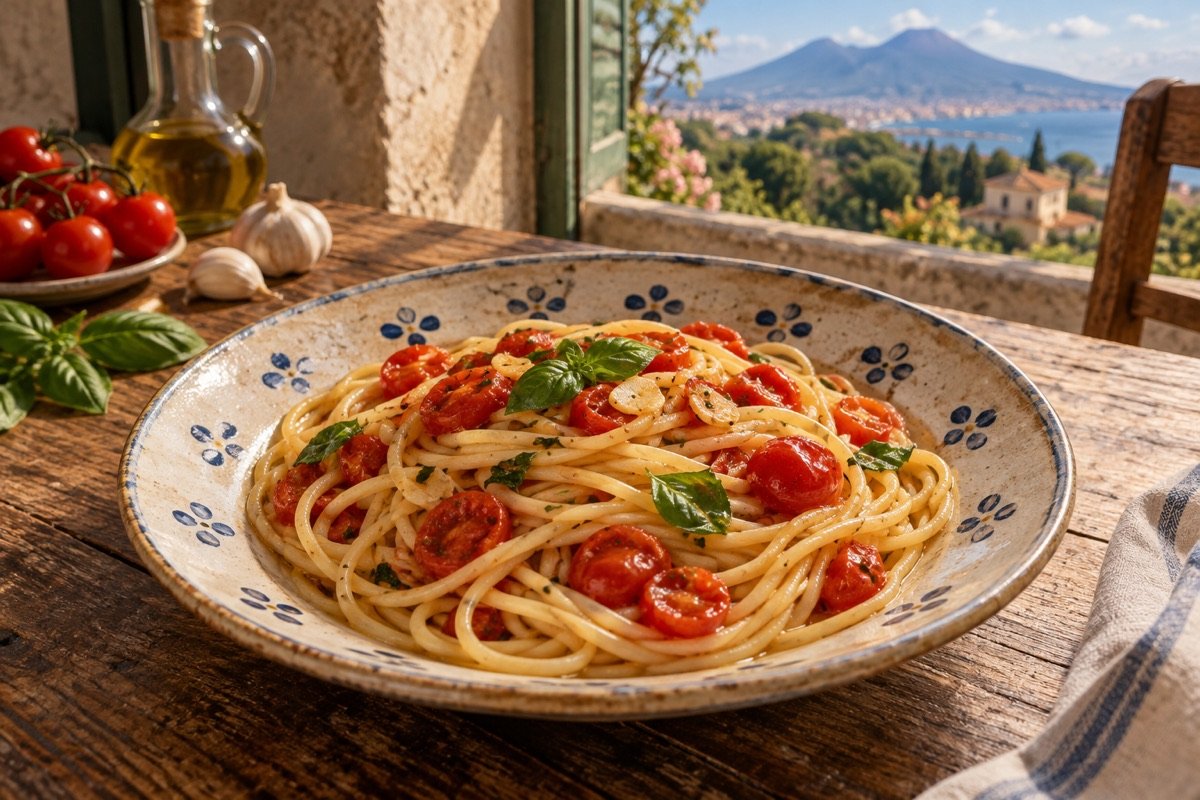
A simple plate of spaghetti allows the tomato to remain the main character.
For a first taste, resist the temptation to build an elaborate recipe. Start with a dish in which every ingredient has a clear reason to be there.
For two people
- 180 to 200 grams dried spaghetti
- 250 to 300 grams Piennolo tomatoes and 2 tablespoons extra virgin olive oil
- 1 small garlic clove, fresh basil and salt
Warm the olive oil gently with the garlic. Add the tomatoes, cut in half, and let them soften just enough to release their juices. Cook the pasta until very al dente, then finish it in the pan with a little pasta water. Add basil at the end.
Do not bury the tomato under ten competing flavours. The pleasure of this dish is discovering how much can happen when pasta, oil and a concentrated tomato meet at exactly the right moment.
- Authentic Pomodorino del Piennolo del Vesuvio PDO — affiliate link coming soon
- Italian dried pasta and extra virgin olive oil — affiliate link coming soon
Chapter 8 — And on Pizza
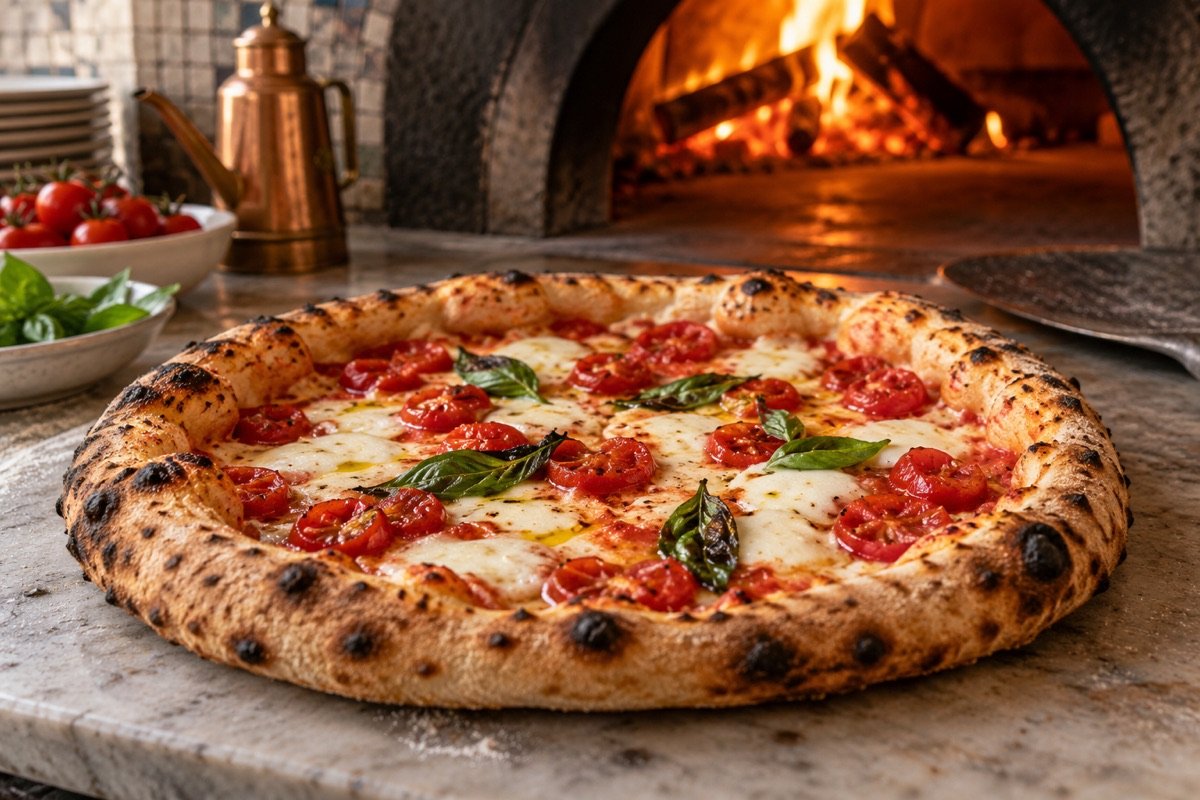
On pizza, the Piennolo brings brightness and concentration without disappearing into a uniform sauce.
Here the conversation becomes serious, because we are practically in the tomato's own neighbourhood.
A Neapolitan-style pizza with mozzarella, olive oil, basil and Piennolo can create a beautiful balance. The tomato brings acidity and intensity. The mozzarella contributes softness and gentle sweetness. The oil carries the aromas, and the heat of the oven gives the edges a new depth.
I prefer not to blend the tomatoes into a completely smooth sauce. Leaving visible pieces reminds you that this is a specific fruit, not merely a red background for cheese.
- Piennolo PDO tomatoes suitable for pizza — affiliate link coming soon
- Italian pizza flour — affiliate link coming soon
- Extra virgin olive oil — affiliate link coming soon
- Pizza stone or home pizza tools — affiliate link coming soon
Chapter 9 — Not Only Fresh: The Tradition of Pacchetelle
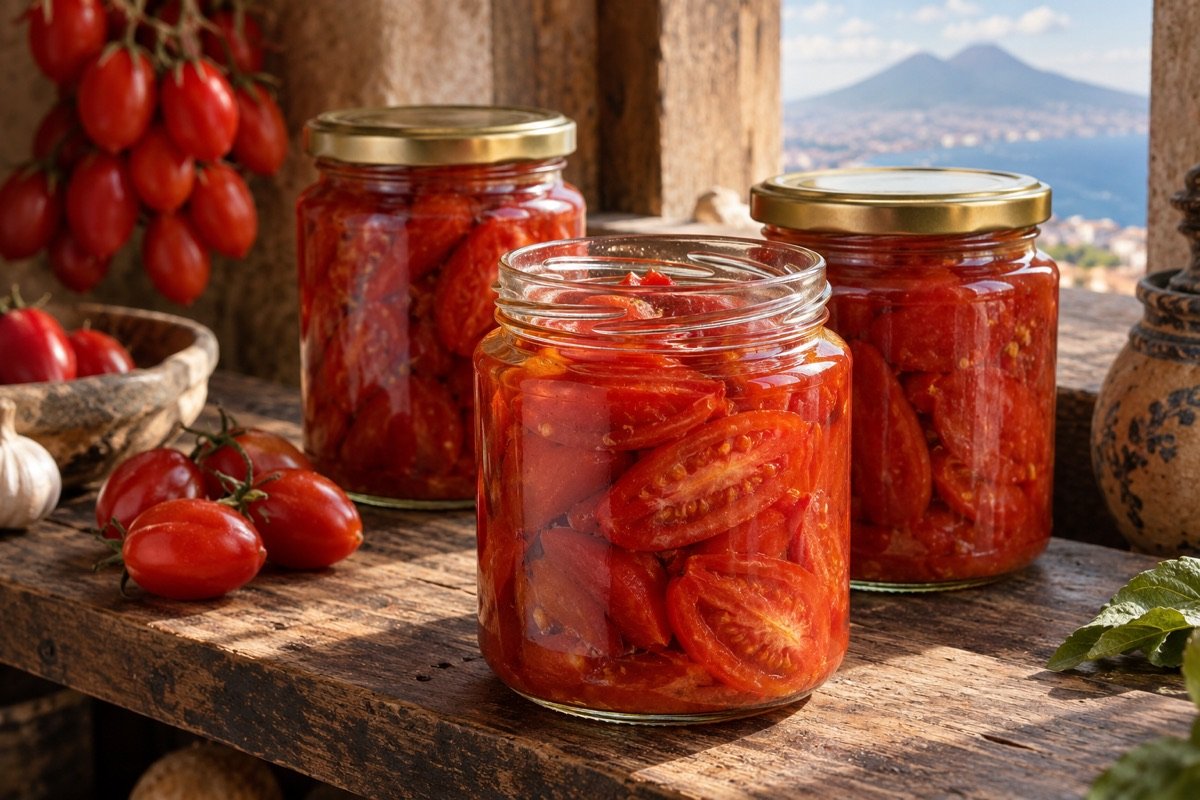
Pacchetelle preserve unpeeled tomatoes cut lengthwise into halves or fillets.
There is another word worth remembering: pacchetelle.
This traditional Vesuvian preserve uses unpeeled Piennolo tomatoes cut lengthwise into halves, wedges or fillets and stored in glass jars. The method is closely tied to the same desire that created the hanging Piennolo: carrying the taste of summer into winter.
Pacchetelle are especially useful when a fresh hanging Piennolo is unavailable or impractical to ship. A good jar still offers texture and a direct tomato flavour that works beautifully in pasta, seafood dishes, pizza and quick sauces.
- Piennolo PDO pacchetelle — affiliate link coming soon
- Artisanal Italian tomato preserves — affiliate link coming soon
Chapter 10 — Piennolo Does Not Automatically Mean PDO
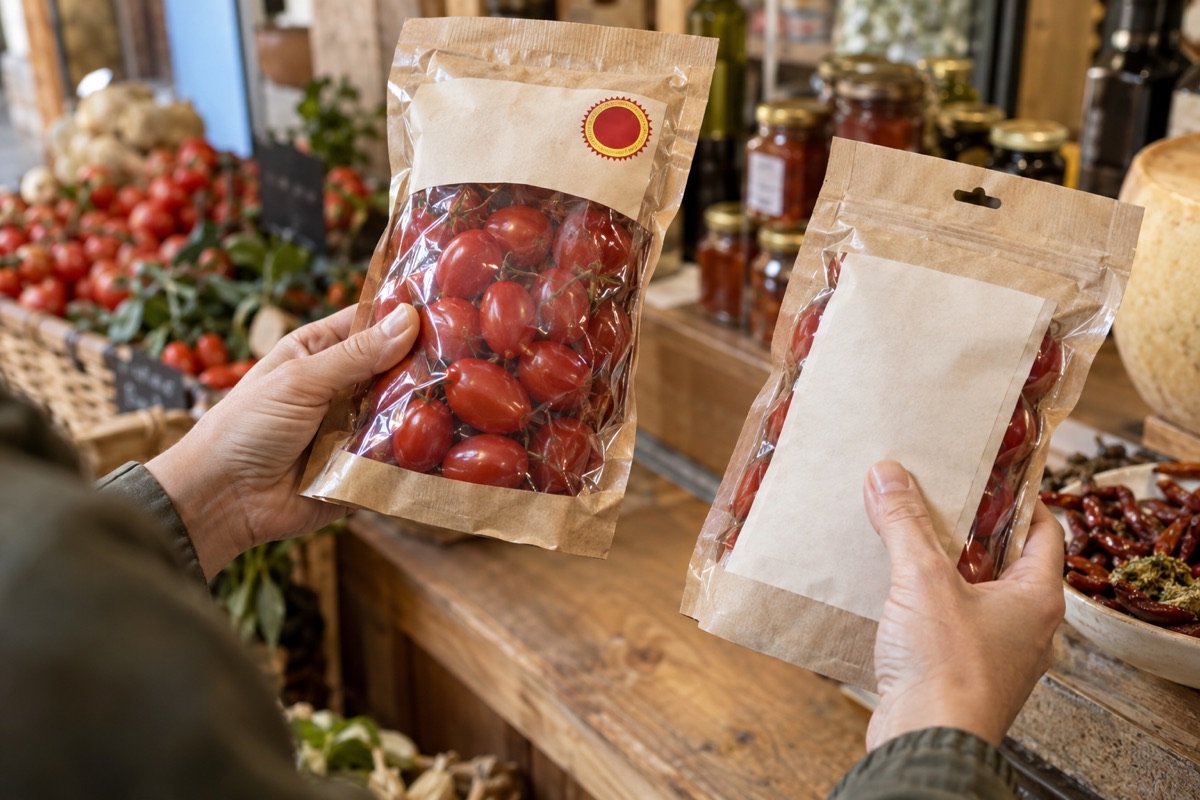
Read the complete product name, origin and certification details rather than relying on rustic packaging.
This distinction matters, especially online. An Italian-sounding name, a picture of Vesuvius and rustic packaging are not enough to prove that a product belongs to the protected designation.
If you want the certified product, look for the complete name Pomodorino del Piennolo del Vesuvio PDO. Check the producer, the place of origin, the product form and the certification information. On European packaging, PDO products normally carry the official red-and-yellow PDO symbol alongside the registered name.
The designation is not decorative language. It refers to a defined production area, an official production specification, traceability and controls. A cheaper tomato may still be enjoyable, but it should not be presented as the protected product if it does not meet those rules.
Chapter 11 — From Naples to the Wider World
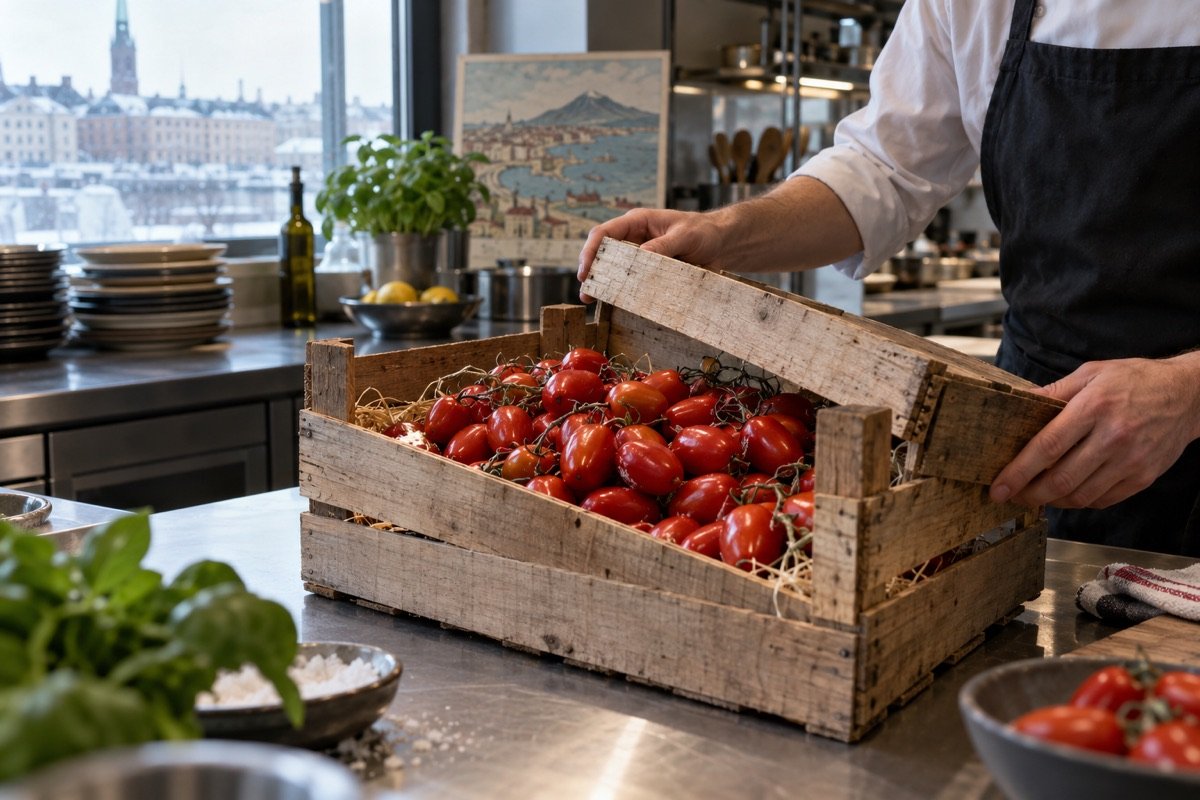
The tomato can travel, but its protected identity always leads back to the Vesuvian production area.
We live in an age when an ingredient from Campania can arrive in a kitchen in Stockholm, London, New York or Tokyo. That is exciting, but it also creates a responsibility: the farther a product travels, the more carefully its identity should be explained.
The Piennolo can cross borders. Its story cannot be detached from Vesuvius. The volcanic terrain, the permitted growing area, the cultivation method and the act of forming and storing the hanging bunch are not optional decorations around the product. They are the reason the product exists in this form.
For chefs, retailers and curious home cooks, buying it should therefore be more than a hunt for novelty. It should be a way of supporting traceable agriculture and discovering how one local solution became a food with international appeal.
Chapter 12 — Five Things to Check Before You Buy
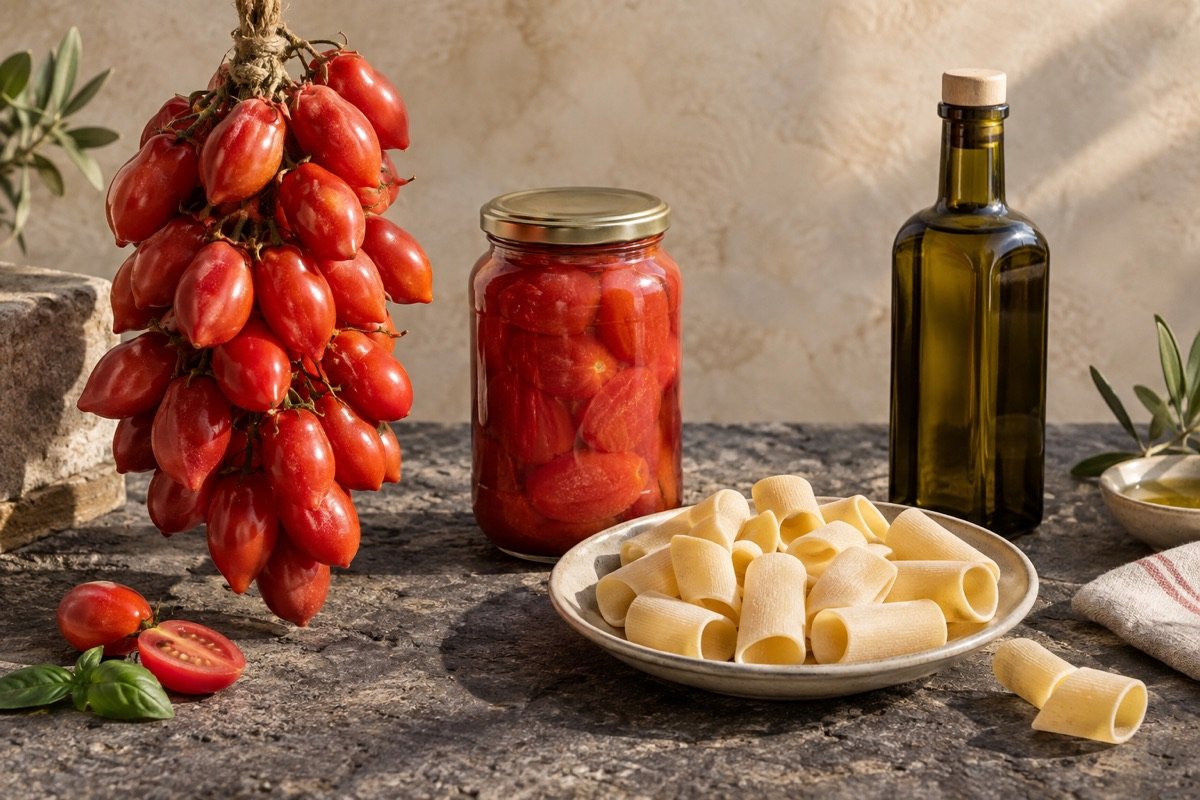
Compare origin, format, ingredients and intended use before choosing a product.
- Read the full protected name. Look for Pomodorino del Piennolo del Vesuvio PDO, not merely Piennolo-style or Vesuvian-style wording.
- Check the producer and origin. The protected area is defined, and traceability is part of the system.
- Choose the right format. A hanging Piennolo offers the most dramatic traditional experience; jars are easier to store and use throughout the year.
- Read the ingredients. For preserved products, a short and clear ingredient list usually makes comparison easier.
- Compare total value, not only price. Consider the weight, certification, shipping conditions, harvest or packing information and how you plan to cook with it.
If you have the opportunity, try the traditional hanging form at least once. Seeing it suspended is part of understanding it. You are not only buying tomatoes; you are meeting an old preservation method that is still alive.
Chapter 13 — A Gift Worth Sharing
Imagine arriving at a dinner with a beautifully presented Piennolo gift box. Before anyone has tasted a tomato, there is already something to talk about: the little pointed fruits, the tied stems, and the volcanic landscape where their story began.
Piennolo tomatoes are also given as gifts, bringing a taste of the Vesuvian countryside to friends and family. A gift box makes a distinctive choice for a food lover, a dinner host or someone who enjoys discovering regional Italian ingredients. It is a present that can become a meal shared together.
Pair it with extra virgin olive oil or a packet of Italian pasta, and include a simple serving suggestion. The pleasure continues when the recipient opens the box again in the kitchen and decides what to cook.
Chapter 14 — A Small Tomato with an Enormous Story
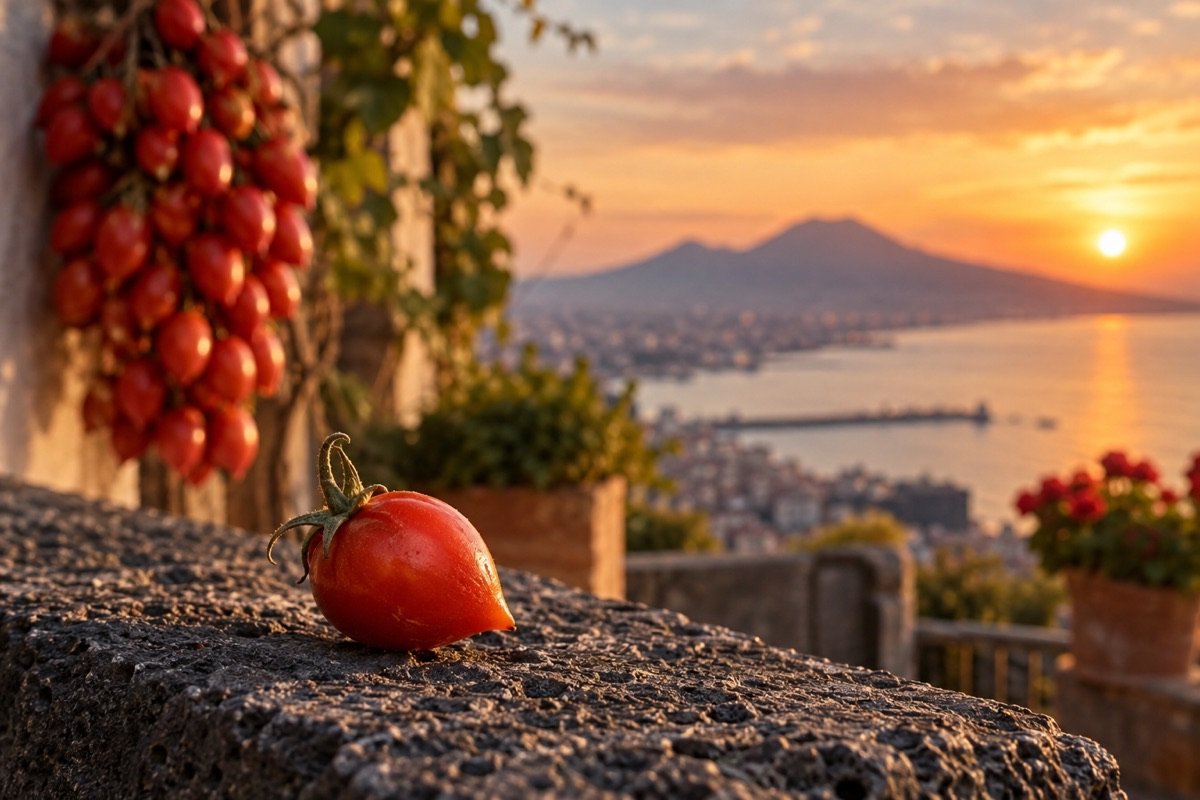
One small tomato can carry the memory of a landscape, a method and generations of practical knowledge.
At the end of this journey, one question remains: is it really only a tomato?
Technically, yes. But that would be like looking at Vesuvius and describing it only as a mountain.
Inside the Pomodorino del Piennolo del Vesuvio are agriculture, climate, volcanic soil, necessity and the ingenuity of families who learned to work with what their land offered. A fruit that might have disappeared with summer was gathered, tied and suspended until it became part of winter.
That is what continues to fascinate me about Italian food. Behind an ingredient that appears simple, there is often a complete world waiting to be discovered.
And sometimes, all it takes to enter that world is to cut open one small red tomato.
— Imran Hossain
Editorial sources: Consorzio di Tutela del Pomodorino del Piennolo del Vesuvio DOP — official consortium information on the designation, territory, typologies and producers. Italian Ministry production specification — official rules covering the product, production area, cultivation, harvest, Piennolo formation, storage, traceability and pacchetelle.
Image note: the pointed tomato close-up and miniature market scene were supplied by the author. The remaining photographs in this article are AI-generated editorial illustrations, not documentary photographs of named farms or certified batches.