The Grandmother Made of Steam: A Winter Pitha Adventure
An imagined journey through Bangladesh’s winter rice cakes, and everything true about them
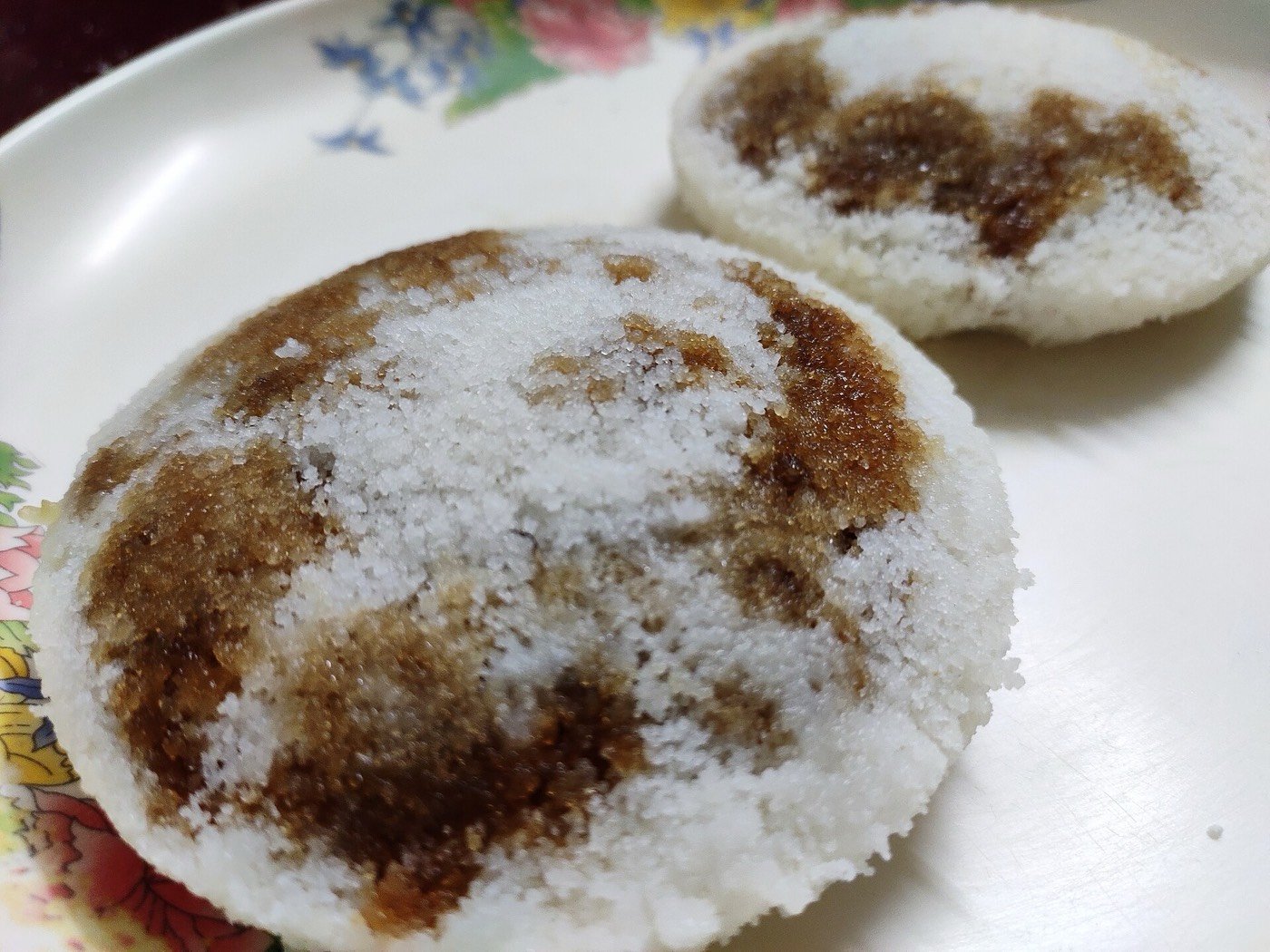
Nadia and the grandmother made of steam are imagined. Everything they tell you about pitha is real. Look for the 🔎 Real fact boxes along the way, and all the sources are listed at the end.
1The First Snow and an Empty Table
The first snow came to the northern city on a Tuesday. Nadia watched it from the window of her small flat, a cup of tea going cold in her hands. Outside, people hurried home to lit windows and families. Inside, there was one chair, one plate and a silence so big she could hear the fridge humming.
It was her first winter far from Bangladesh. At home, winter meant fog over the fields, the smell of smoke and jaggery in the morning, and someone always calling, “Come, eat while it’s hot!” Here, nobody called.
She opened her suitcase to find a warm scarf, and her fingers touched something hard and round, wrapped in an old cotton sari. It was a small clay pan, dark from years of fire. Her grandmother must have hidden it there. Tucked inside was a tiny bag of rice flour and a note in shaky handwriting: “So you never eat winter alone.”
Nadia laughed and cried at the same time. Then she put the pan on the stove, just to feel its warmth. And that is when the steam began to speak.
2Who Invented Pitha?
The steam rose and curled and slowly became a face: an old woman with kind, crinkled eyes and a shawl that moved like smoke.
“Don’t be frightened, child,” she said. “I am the grandmother of every pitha. Every winter, when someone is far from home, I come out of a clay pan. Tonight I will show you where your pitha comes from. Hold my shawl.”
“Wait,” whispered Nadia. “Are you the one who invented pitha?”
The steam grandmother laughed, and the kitchen smelled of coconut. “Nobody invented pitha, child. There is no name in any history book. No king ordered it and no famous cook signed it. Pitha was invented by thousands of women whose names nobody wrote down: mothers, grandmothers and neighbours in the villages of Bengal, each one adding a shape, a filling or a trick, and teaching it to her daughter by the fire. That is why pitha belongs to everyone.”
No single inventor or date of invention is known for pitha. It is a traditional home-made food of Bengal, passed from generation to generation, usually by mothers and grandmothers. Pitha is made across the eastern Indian subcontinent: in Bangladesh, West Bengal, Assam and Odisha. Bengal has hundreds of varieties, and the same pitha often has different names in different districts.
3The Golden Field of New Rice
The kitchen disappeared. Nadia was standing at the edge of a field, golden in the late-autumn sun. Farmers were cutting the paddy, and children ran between the bundles. From a courtyard came a steady thump, thump, thump: a woman was pounding rice with a long wooden dheki, rising and falling like a seesaw.
“This is where pitha begins,” said the steam grandmother. “With the new rice. Every year, after the harvest, people celebrate Nobanno, the festival of new rice. The fresh rice is pounded into flour, and the first pitha of the season are made. No new rice, no pitha.”
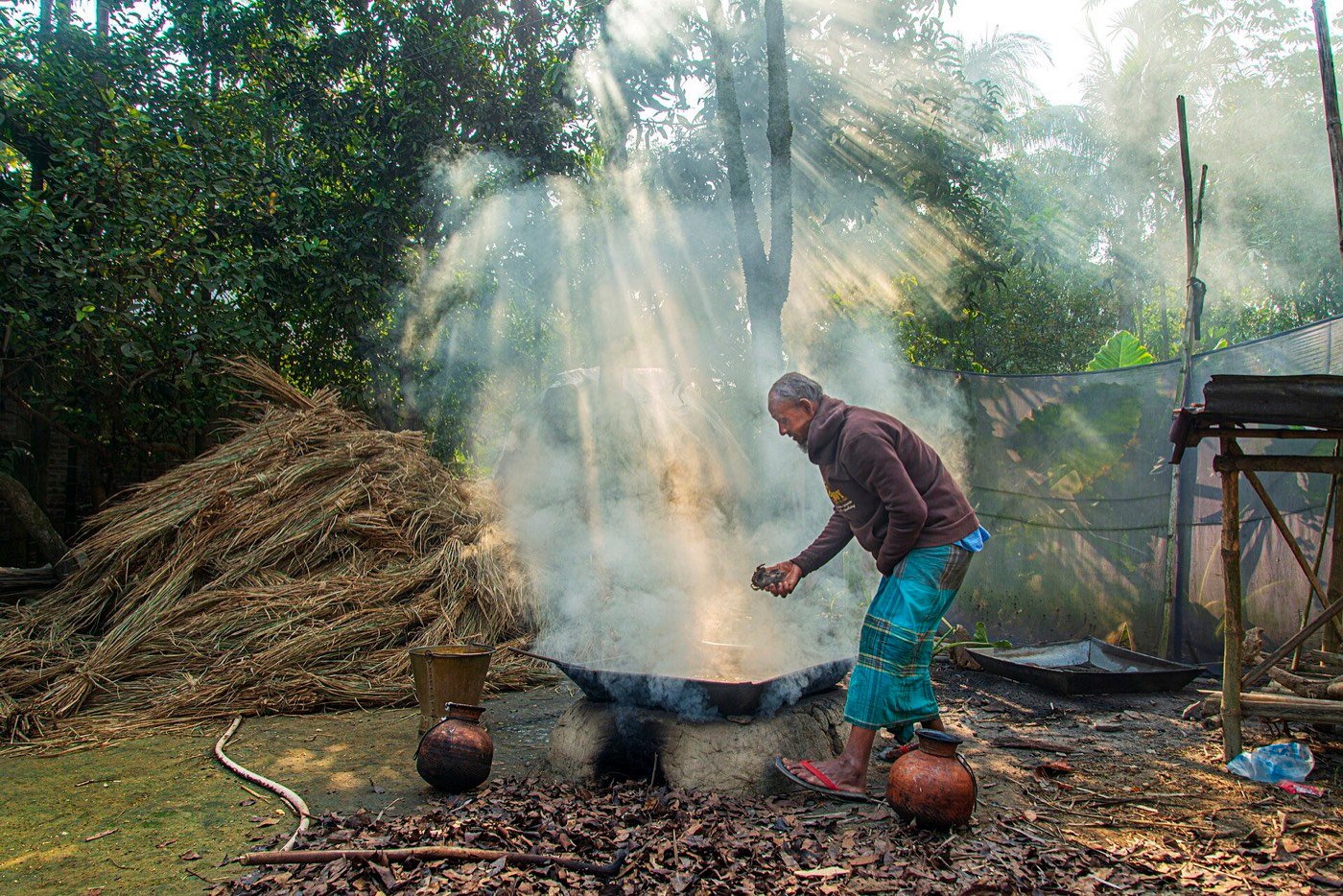
The pitha season starts in late autumn, when farmers harvest the paddy. Nobanno, the harvest festival of newly harvested rice, takes place in the Bengali month of Agrahayan, with music, food and rice pounding with the dheki in rural courtyards. Most pitha are made from rice flour; a few use wheat flour.
4The Date Palm at Dawn
A cold wind blew, and the field turned into a misty morning. A man was climbing a tall date palm with a rope around his waist. At the top hung a clay pot.
“He tied that pot last evening,” said the grandmother. “All night, sweet sap dripped into it. Now he brings it down before the sun warms it. Watch what happens next.”
Below, a fire burned under a huge, wide pan. The sap bubbled and thickened for hours, turning gold, then amber, then dark brown. The air filled with the most wonderful smell in the world.
“Khejur gur,” said Nadia softly. “Date palm jaggery.”
“The soul of winter pitha,” said the grandmother. Then her face became serious. “But listen, child. Never drink the sap raw. At night, bats visit the pots, and raw sap can carry a dangerous sickness. Always boil it.”
Date palm sap is collected from about November to February. Clay pots are tied to the tops of the trees, the sap collects overnight and is taken down early in the morning, then boiled for hours into molasses and jaggery. Bangladesh’s health authorities warn people not to drink raw date palm sap, because it can carry the Nipah virus. Boiling the sap is the safe way.
5The Roadside Fire
Now they stood on a town street in the early evening. Under a streetlight, a woman crouched beside a small mud stove. On it sat a pot of boiling water, covered with a cloth. Steam puffed out like a little train.
“Bhapa pitha,” said the grandmother, and Nadia’s mouth began to water. The woman pressed damp rice flour into a small bowl, added grated coconut and a spoon of jaggery in the middle, covered it with more flour, wrapped it in cloth and set it over the steam. A few minutes later, out came a soft white cake with a river of melted gur inside.
Next to her, a man was pouring a thin batter into round clay moulds over a fire. The batter puffed up, white and spongy. “Chitoi pitha,” said the grandmother. “Just rice flour, salt and water. Eat it with hot mustard paste, or dried-fish bhorta. Or soak it in sweet milk and gur and call it dudh chitoi. Everyone has a favourite way.”
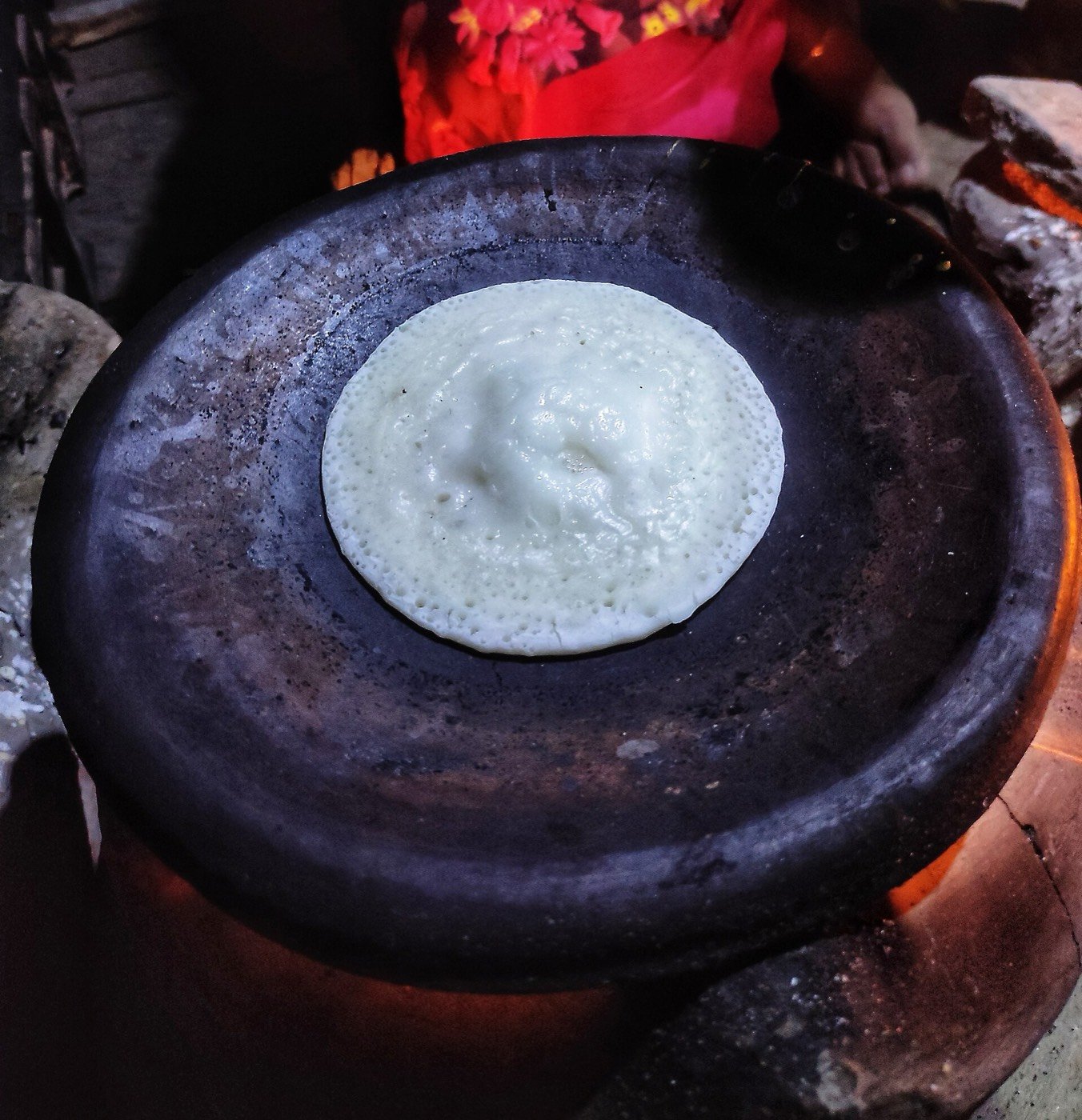
Chitoi on the clay pan
With bhapa, chitoi is one of the two most popular pitha in and around Dhaka.
Photo: Sm faysal, resized, CC BY-SA 4.0, via Wikimedia Commons.
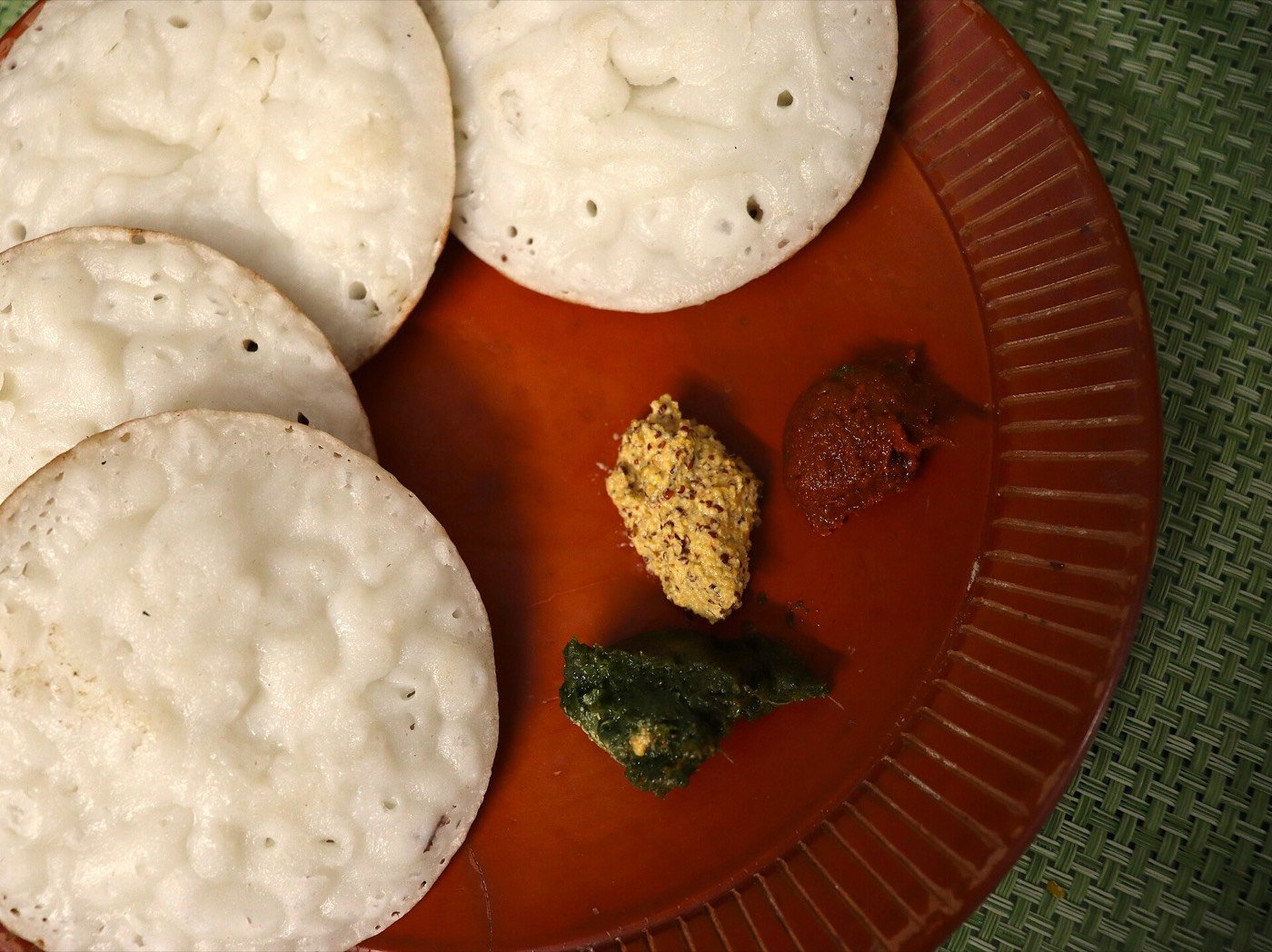
Chitoi with bhorta
Plain chitoi with spicy mustard, dried fish (shutki) or chilli bhorta.
Photo: Evening42, resized, CC BY-SA 4.0, via Wikimedia Commons.
Pitha are steamed, fried or cooked on a griddle. Many are stuffed: in Bengali, the outer shell is called the khol and the filling is the pur. Most pitha are sweet, made with jaggery or sugar, coconut, sesame, nuts or cardamom, but some are savoury, filled with vegetables or meat. In cities, specialist shops sell pitha, and street vendors sell cheaper ones.
6The Courtyard of Patterns
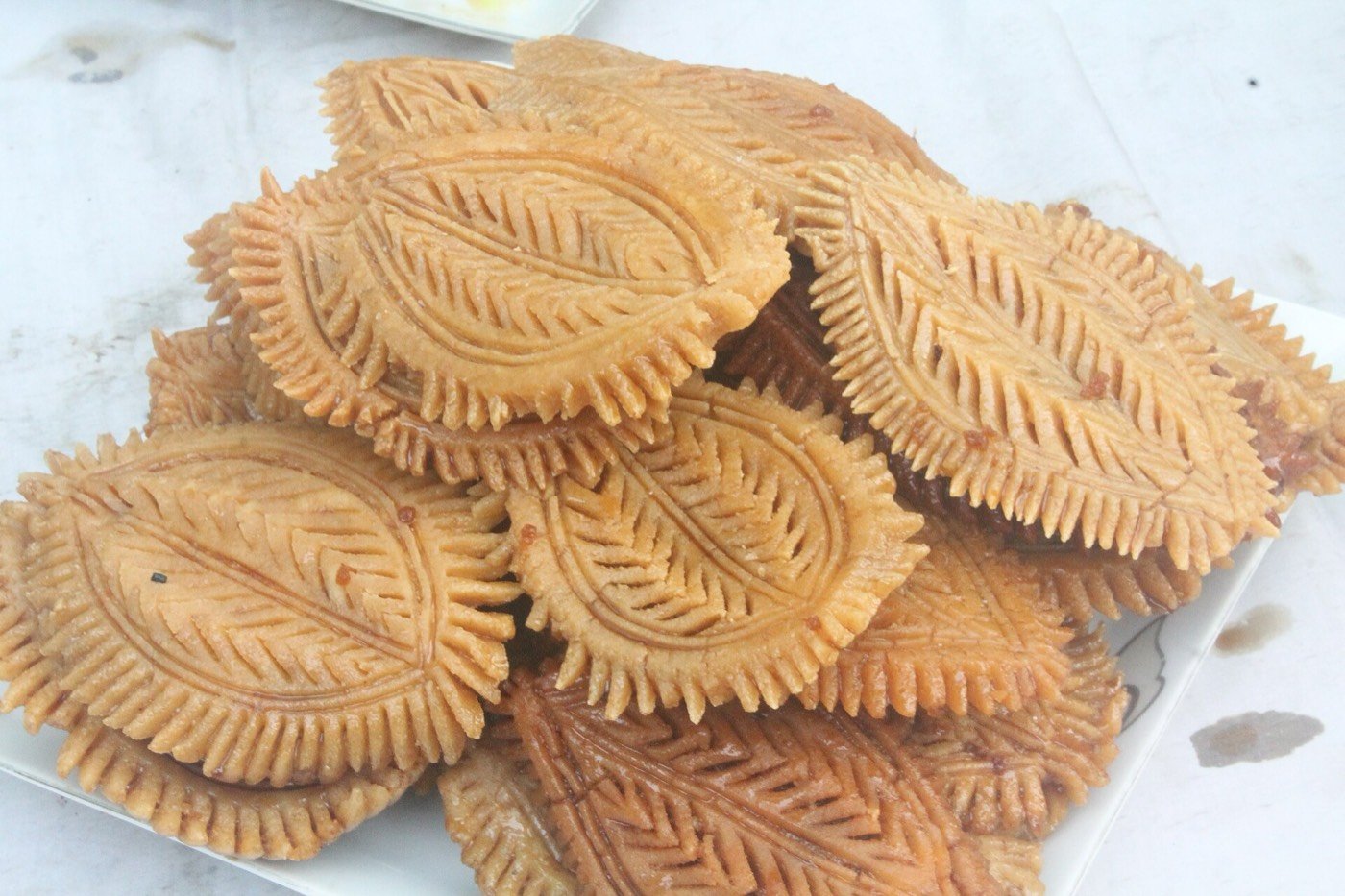
The street faded, and Nadia found herself in a quiet courtyard in Mymensingh. A group of women sat on a mat, laughing and talking. Each one held a flat piece of rice dough, and with a date thorn or a needle she was drawing on it: leaves, creepers, flowers and a lotus opening its petals.
“This is nakshi pitha,” said the grandmother proudly. “Nakshi means design. These cakes are fried and soaked in syrup, but first they become art. The women here are famous for it. Every pattern has a name. That one is padmadighi, the lotus pond. And that one,” she winked, “is jamaimukh, the son-in-law’s face.”
One woman was folding half-moon dumplings filled with coconut and gur, pinching the edges so they looked like flower petals. “Puli pitha,” said the grandmother. “Fried, steamed, or simmered in sweet milk as dudh puli.” Another was rolling thin crêpes around a filling of coconut and jaggery. “And patishapta, the best friend of a cup of tea.”
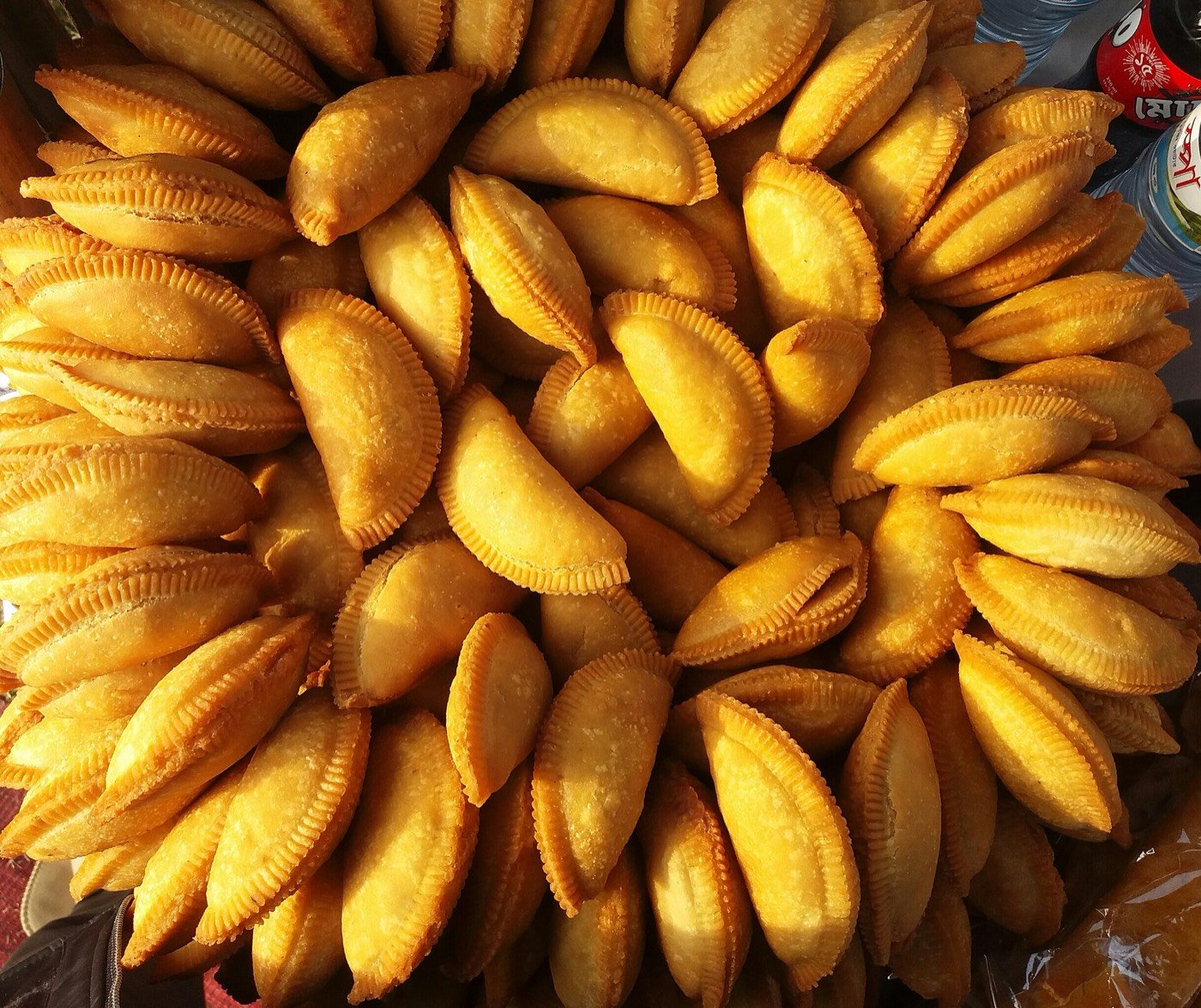
Puli pitha
Half-moon dumplings with petal-like edges, stuffed with coconut and gur.
Photo: Mmrsafy, resized, CC BY-SA 4.0, via Wikimedia Commons.
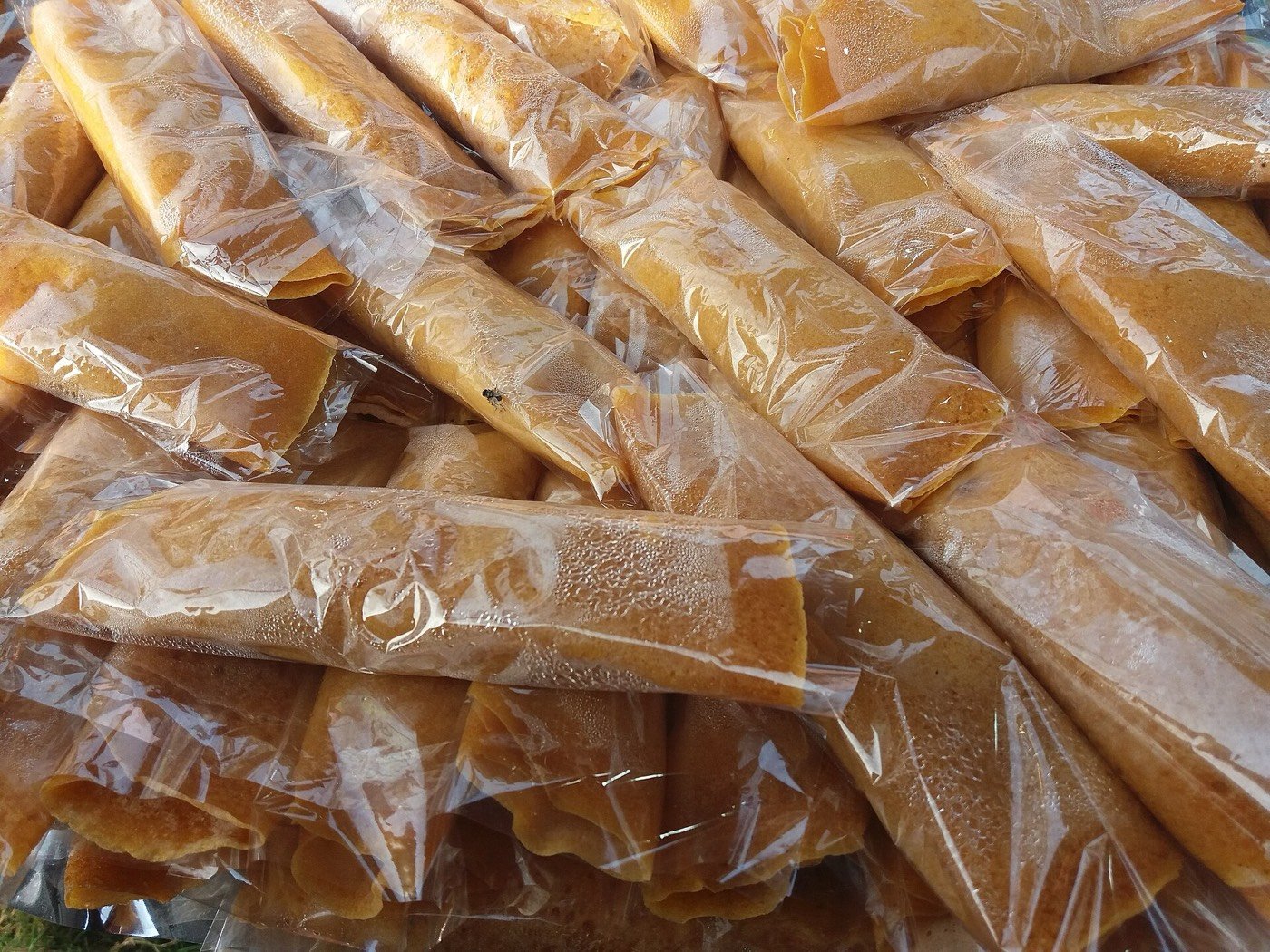
Patishapta
Thin rice-flour crêpes rolled around coconut and jaggery, or thickened milk (kheer).
Photo: Mmrsafy, resized, CC BY-SA 4.0, via Wikimedia Commons.
Banglapedia calls nakshi pitha both a culinary art and an important women’s folk art. Designs are drawn with date thorns, hairpins, needles, jute sticks or twigs, and plants, creepers, flowers and the lotus are popular motifs. The women of Mymensingh are especially admired for their designs, which have names such as padmadighi, kajal lata and jamaimukh.
7The Wedding Night
Music. Lights. A house full of people in their best clothes. A new bridegroom had arrived, a little nervous, and the women of the bride’s family carried out trays piled high with pitha.
“That colourful one with the tiny designs is bibiana,” whispered the grandmother. “Its name means ‘the bride’s skill’. And that one is jamai bhulana. They say it is made to win the heart of the new son-in-law.” The bridegroom took one bite, and everyone cheered.
Nadia looked around. There was a huge pitha on one tray and tiny ones on another, cakes wrapped in leaves and crunchy fried ones shining with syrup. Nobody was eating alone. Old aunts fed children, neighbours passed plates, and the conversation never stopped.
- Hadi pitha: the big one
- Khejur pitha: the small one
- Pata pitha: wrapped in leaves
- Pakan: fried, patterned, in syrup
- Tel pitha (Handesh): from Sylhet
In Bangladesh, pitha are made to welcome a new bride or bridegroom, to entertain guests and for family gatherings, and neighbouring families sometimes make them together. Banglapedia describes bibiana (“bride’s skill”) and jamai bhulana as pitha made for a new bridegroom. Pitha are also made for Eid, puja festivals and family ceremonies such as aqiqah and annaprashan. In 1991, an exhibition in Dhaka showed 106 categories of pitha.
8The Festival of a Thousand Plates
The wedding lights became festival lights. Nadia stood in a wide square in Dhaka, crowded with stalls. Drums played on a stage. Every stall was piled with pitha she had never seen before.
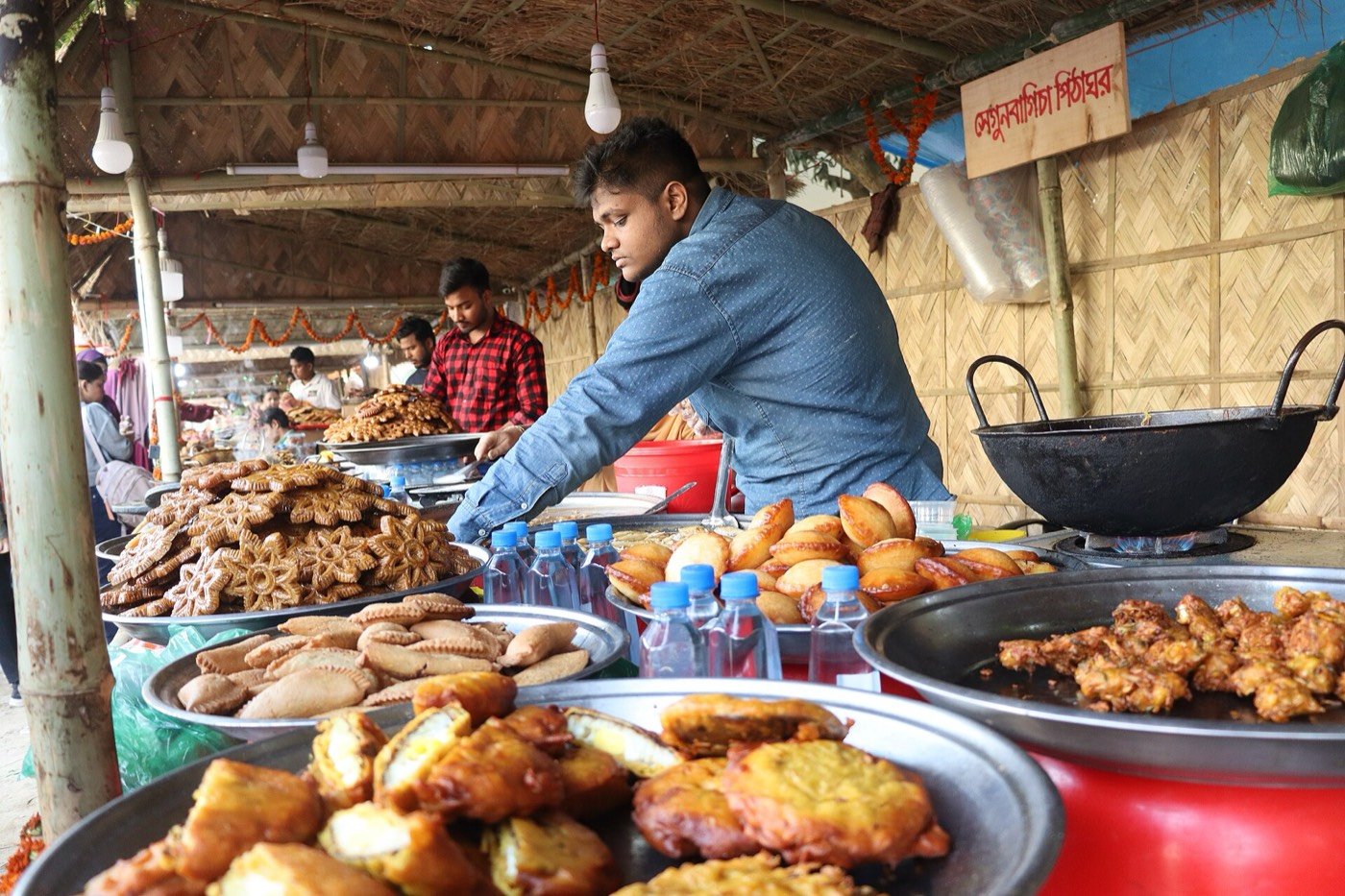
“Every district brings its own pitha here,” said the grandmother. “You could taste a different one every hour and still not finish. And look, child: not one of these people is a stranger at a pitha stall.”
The biggest pitha festival is the Jatiya Pitha Utsab, the National Pitha Festival, held at the Bangladesh Shilpakala Academy in Dhaka with the Ministry of Cultural Affairs. It usually runs for about ten days in January or February. One edition had more than 50 stalls from different districts showing over 200 pitha items. Smaller pitha festivals are held at Dhaka University and in neighbourhoods, and one edition was held in Sylhet.
Pitha has cousins across the region. In Assam, pitha made from sticky rice are part of the Bihu festival. In Odisha, pitha are festive temple foods and part of the offering at the Jagannath Temple in Puri.
9Back to the Snow
The music faded. Nadia blinked. She was in her small kitchen again, and the clay pan was warm under her hand. The steam grandmother was almost gone, just a soft curl above the stove.
“Wait!” said Nadia. “Will I see you again?”
“Every time you make pitha for someone,” the grandmother whispered. “Remember, child: pitha was never meant to be eaten alone.” And she was gone.
Nadia opened the little bag of rice flour. She had no khejur gur, but she had brown sugar and a packet of grated coconut. She found a small bowl and a clean cloth, and she set a pot of water to boil. Her first bhapa came out crooked. The second was better. By the sixth, the whole flat smelled like a winter morning in Bangladesh.
Then she did something she had not done since she arrived. She put the pitha on a plate, walked down the hall and knocked on her neighbour’s door. An old man opened it. He looked surprised, then curious, then he smiled.
That night, there were two chairs at Nadia’s table. By the end of winter, there were five.
10Pitha at a Glance
| Pitha | How it is cooked | Taste | Best with |
|---|---|---|---|
| Bhapa | Steamed | Sweet: coconut and gur | Eaten hot, straight from the steamer |
| Chitoi | Clay or iron pan | Plain and soft | Mustard, shutki or chilli bhorta |
| Dudh chitoi | Chitoi soaked in milk | Sweet and creamy | A cold winter evening |
| Patishapta | Thin crêpe, rolled | Sweet, or spicy (jhal) | Tea |
| Puli | Fried, steamed or in milk | Sweet coconut filling | Family gatherings |
| Nakshi | Carved, fried, in syrup | Crisp and sweet | Weddings and guests |
| Pakan | Fried, in syrup | Crunchy and sweet | Festive trays |
On a small screen, swipe the table sideways.
Try it like Nadia: simple bhapa at home
- Mix rice flour with a pinch of salt and sprinkle in a little water until it feels like damp sand.
- Fill a small bowl halfway with the flour, add grated coconut and a spoon of khejur gur (or brown sugar), then cover with more flour.
- Cover the bowl with a thin damp cloth, turn the cake out onto the cloth and fold it over.
- Steam it over a pot of boiling water, covered with a lid, for a few minutes until firm.
- Eat it hot. And if you can, share it.
A letter to you, if you are reading this alone
Maybe you are far from home tonight, like Nadia. Maybe the city outside is busy and your table is quiet. If so, I want you to know something: you are not the only one, and you are welcome here.
This blog is a small table where food from Europe and Asia sits together, and so can we. Tell me which pitha you miss most, or which food makes you feel at home. Send me a photo of something you cooked, even if it came out crooked like Nadia’s first bhapa. It may appear here on the blog.
And if you would like a new story to keep you company, join below. I’ll write to you when the next one is ready.
— Imran Hossain
Never eat winter alone
Get new food stories from Euroasia Food Culture by email.
We send a confirmation email first, and you can unsubscribe at any time. See our privacy notice.
Sources:
- Banglapedia: Pitha, its types, season and customs
- Banglapedia: Nakshi Pitha, designs and tools
- Pitha: ingredients, khol and pur, regional styles
- The Daily Star: Pitha, the heart of winter celebrations
- The Daily Star: A pitha for every mood
- Bangladesh Post: Jatiya Pitha Utsab underway at BSA
- Dhaka Courier: National Pitha Utsab at BSA
- The Financial Express: DGHS warns against drinking raw date juice
- The Business Standard: Nipah virus and winter date sap
The story of Nadia and the grandmother made of steam is imagined. The facts about pitha come from the sources above. All photographs are real photographs shared under free licences on Wikimedia Commons, credited under each one.